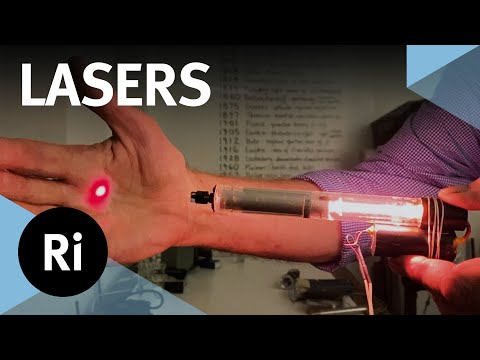
The laser is a key part of so much of our modern world, from fibre-optic cabling to eye surgery.
The origin story of lasers goes all the way back to the pioneering work of Isaac Newton. Join Andrew as he spins a tale of the the study of light and lasers, from Newton's prisms to the Nobel prize winning laser photochemistry of George Porter.
Andrew would like to thank Steve Conduit, physics technician at Highgate School, and Jonathan Ryder, precision engineer, for their considerable help in the preparation and explanation of the demonstrations on this talk.
Chapters:
00:00 - Introduction
03:50 - What is a laser?
06:28 - Newton and the prism
09:42 - The wave theory of light
10:50 - Everyday types of light
14:41 - Young and diffraction
16:24 - Dalton's atomic theory
17:50 - Lines in the solar spectrum
20:00 - Faraday and electromagnetism
22:45 - The spectroscope and spectral analysis
29:14 - Matter and light
35:20 - Crookes' radiometer
39:12 - JJ Thompson and the electron
41:29 - Planck's constant
45:08 - Albert Einstein and the photoelectric effect
47:25 - Looking inside the atom
50:54 - Exciting electrons and the laser
53:00 - Metastability
54:45 - The first lasers
56:20 - A modern gas laser
Andrew Szydlo is a chemist and secondary school teacher at Highgate School, well-loved by pupils and Ri attendees alike. He has given public lectures around the country, been featured on TV shows and has become a popular regular face on our channel.
Subscribe for regular science videos: http://bit.ly/RiSubscRibe
The Ri is on Patreon: https://www.patreon.com/TheRoyalInstitution
and Twitter: http://twitter.com/ri_science
and Facebook: http://www.facebook.com/royalinstitution
and Tumblr: http://ri-science.tumblr.com/
Our editorial policy: http://www.rigb.org/home/editorial-policy
Subscribe for the latest science videos: http://bit.ly/RiNewsletter
,Ri,Royal Institution,royal institute,WfCItXZ7dFo,UCYeF244yNGuFefuFKqxIAXw, Knowledge, channel_UCYeF244yNGuFefuFKqxIAXw, video_WfCItXZ7dFo,2025 is the International Year of Quantum Science and Technology, as marked by the UN, to celebrate 100 years since the birth of quantum mechanics. But quantum science is one of the least diverse areas of science in terms of gender and other protected characteristics.
Jess Wade, a physicist and lecturer in functional materials at Imperial College London, has been fighting the inequality in quantum physics and beyond by creating thousands of Wikipedia pages for women scientists. Jess joins us this month to discuss the past, present, and future of quantum science along with what can be done to increase diversity within the field.
Ri Science Podcast episodes are released on the last Wednesday of every month. Subscribe wherever you get your podcasts to be notified as soon as episodes are released!
---
Jess Wade is a British physicist in the Blackett Laboratory at Imperial College London, specialising in Raman spectroscopy. Her research investigates polymer-based organic light emitting diodes (OLEDs). Her public engagement work in science, technology, engineering, and mathematics (STEM) advocates for women in physics as well as tackling systemic biases such as gender and racial bias on Wikipedia. Read more about here here: https://en.wikipedia.org/wiki/Jess_Wade
---
Producer: Lia Hale
Assistant producers: Katie Mortimer, Isla Nakano
Interviewer: Lia Hale
Music: Joseph Sandy
--
Join this channel to get access to perks:
https://www.youtube.com/channel/UCYeF244yNGuFefuFKqxIAXw/join
Subscribe for regular science videos: http://bit.ly/RiSubscRibe
The Ri is on Twitter: http://twitter.com/ri_science
and Facebook: http://www.facebook.com/royalinstitution
and TikTok: https://www.tiktok.com/@ri_science
Listen to the Ri podcast: https://podcasters.spotify.com/pod/show/ri-science-podcast
Donate to the RI and help us bring you more lectures: https://www.rigb.org/support-us/donate-ri
Our editorial policy: https://www.rigb.org/editing-ri-talks-and-moderating-comments
Subscribe for the latest science videos: http://bit.ly/RiNewsletter
Product links on this page may be affiliate links which means it won't cost you any extra but we may earn a small commission if you decide to purchase through the link.
,Ri,Royal Institution,royal institute,MdOCu2Gr-0g,UCYeF244yNGuFefuFKqxIAXw, Knowledge, channel_UCYeF244yNGuFefuFKqxIAXw, video_MdOCu2Gr-0g,Join this channel to get access to perks:
https://www.youtube.com/channel/UCYeF244yNGuFefuFKqxIAXw/join
Subscribe for regular science videos: http://bit.ly/RiSubscRibe
The Ri is on Twitter: http://twitter.com/ri_science
and Facebook: http://www.facebook.com/royalinstitution
and TikTok: https://www.tiktok.com/@ri_science
Listen to the Ri podcast: https://podcasters.spotify.com/pod/show/ri-science-podcast
Donate to the RI and help us bring you more lectures: https://www.rigb.org/support-us/donate-ri
Our editorial policy: https://www.rigb.org/editing-ri-talks-and-moderating-comments
Subscribe for the latest science videos: http://bit.ly/RiNewsletter
Product links on this page may be affiliate links which means it won't cost you any extra but we may earn a small commission if you decide to purchase through the link.
,Ri,Royal Institution,royal institute,PLc0BCjbFcg,UCYeF244yNGuFefuFKqxIAXw, Knowledge,Religion, channel_UCYeF244yNGuFefuFKqxIAXw, video_PLc0BCjbFcg,In the first of his CHRISTMAS LECTURES, Richard Dawkins explores the origins of life. Beginning with a look at our ancestry, he shows how the probability of our existence is very small.
Watch all the lectures in this series here: https://www.youtube.com/playlist?list=PLbnrZHfNEDZwJw3_jDeusmHuVYDdKRpo9
Watch our newest Christmas lectures here: https://www.youtube.com/playlist?list=PLbnrZHfNEDZyQJZLPMjwEoOLdkFBLU2m1
This lecture was filmed at the Ri on 1 December 1991.
These lectures were originally a YouTube member exclusive for our Science Supporters, and now we’re putting them out for everyone to watch. If you can’t wait for them all to be published, get access now by signing up as a YouTube channel member, and help us bring science to more people: https://www.youtube.com/channel/UCYeF244yNGuFefuFKqxIAXw/join
---
Life grows up in the universe by gradual degrees of evolution. Billions of years ago, there existed a vast population of bacteria. But it was only an elite group of these bacteria that evolved to become humans. In truth, we are lucky to be alive.
In the first of his CHRISTMAS LECTURES, Richard Dawkins explores the origins of life. Beginning with a look at our ancestry, he shows how the probability of our existence is very small. Becoming an ancestor is much more difficult than simple reproduction, and Richard reveals how our ancestors did what it took to survive and pass on their genes.
But although some of our life must be devoted to perpetuating it, surely there must be more to it? Richard explores the role of art and culture in society, and examines how the capabilities of the human body have enabled us to accomplish complex tasks.
When it comes to our understanding of the meaning of life, science is important. As Richard explains, science can help us uncover both when we arrived on this planet, and why we are here. Some people turn to the supernatural for the answer to such questions. Richard looks at the limitations of beliefs in the supernatural and uses a cannonball to prove why instead we should have faith in science and its predictions.
--
About the 1991 CHRISTMAS LECTURES
The world-famous evolutionary biologist Richard Dawkins presents the CHRISTMAS LECTURES on "our own growing knowledge of how life grows up in the universe."
Just as children grow up to be adults, so too does life gradually evolve on a planet over thousands of generations, to move from “nonliving simplicity” to become “living complexity”.
Combining beautiful writing with a range of illuminating demonstrations, the series featured a variety of wildlife, a virtual reality Lecture Theatre, and special guests – including the late Douglas Adams reading an excerpt from The Hitchhiker's Guide to the Galaxy.
Find out more about the Ri CHRISTMAS LECTURES here: https://www.rigb.org/christmas-lectures
---
Join this channel to get access to perks:
https://www.youtube.com/channel/UCYeF244yNGuFefuFKqxIAXw/join
Subscribe for regular science videos: http://bit.ly/RiSubscRibe
The Ri is on Twitter: http://twitter.com/ri_science
and Facebook: http://www.facebook.com/royalinstitution
and TikTok: https://www.tiktok.com/@ri_science
Listen to the Ri podcast: https://podcasters.spotify.com/pod/show/ri-science-podcast
Donate to the RI and help us bring you more lectures: https://www.rigb.org/support-us/donate-ri
Our editorial policy: https://www.rigb.org/editing-ri-talks-and-moderating-comments
Subscribe for the latest science videos: http://bit.ly/RiNewsletter
Product links on this page may be affiliate links which means it won't cost you any extra but we may earn a small commission if you decide to purchase through the link.
,Ri,Royal Institution,royal institute,sO5adbV_mu8,UCYeF244yNGuFefuFKqxIAXw, Knowledge, channel_UCYeF244yNGuFefuFKqxIAXw, video_sO5adbV_mu8,Watch the Q&A for Sean Carroll's lecture on Einstein's equation explaining spacetime. You can watch the original lecture here: https://youtu.be/BRudidBcfXk
The original lecture and this Q&A were recorded at the Ri on Monday 14 August 2023.
Our lecture Q&As are usually a perk for our YouTube Science Supporters, as a thank you for helping us bring science to more people, but we're publishing this one for everyone as Sean's talk has been so popular.
A huge thank you to our YouTube members for helping us to bring you more science. You can join them here: https://www.youtube.com/channel/UCYeF244yNGuFefuFKqxIAXw/join
Subscribe for regular science videos: http://bit.ly/RiSubscRibe
The Ri is on Twitter: http://twitter.com/ri_science
and Facebook: http://www.facebook.com/royalinstitution
and TikTok: https://www.tiktok.com/@ri_science
Listen to the Ri podcast: https://podcasters.spotify.com/pod/show/ri-science-podcast
Our editorial policy: https://www.rigb.org/editing-ri-talks-and-moderating-comments
Subscribe for the latest science videos: http://bit.ly/RiNewsletter
Product links on this page may be affiliate links which means it won't cost you any extra but we may earn a small commission if you decide to purchase through the link.
,1,Join this channel to get access to perks:
https://www.youtube.com/channel/UCYeF244yNGuFefuFKqxIAXw/join
Subscribe for regular science videos: http://bit.ly/RiSubscRibe
The Ri is on Twitter: http://twitter.com/ri_science
and Facebook: http://www.facebook.com/royalinstitution
and TikTok: https://www.tiktok.com/@ri_science
Listen to the Ri podcast: https://podcasters.spotify.com/pod/show/ri-science-podcast
Donate to the RI and help us bring you more lectures: https://www.rigb.org/support-us/donate-ri
Our editorial policy: https://www.rigb.org/editing-ri-talks-and-moderating-comments
Subscribe for the latest science videos: http://bit.ly/RiNewsletter
Product links on this page may be affiliate links which means it won't cost you any extra but we may earn a small commission if you decide to purchase through the link.
,1,A Tampa Police Reserve Officer says his department-issued service weapon fired without pulling the trigger, seriously injuring him. The 30-year veteran of the force is now suing the company that manufactures the firearm. Last February, Bob Northrop was working an extra duty assignment as a TPD Reserve Officer patrolling Jefferson High School during a baseball game. Northrop says he was standing just feet from students and their families when his hand brushed his holstered service weapon. The 69-year-old needed emergency surgery after a 9mm hollow-point bullet shattered his leg and ankle, causing permanent injuries.Last week, Northrop and his legal team filed a civil suit against gun maker Sig Sauer "…for the design, manufacture, sale, distribution, inadequate warnings related to an unreasonably dangerous and defective firearm." The suit says the P320 handgun can fire with just a bump, tap, vibration or drop. Putting officers and everyone around them at risk of being shot, injured or killed. FOX 13 News reached out to both the Tampa Police Department and Sig Sauer about this lawsuit. TPD says it does not comment on pending litigation, and so far, Sig Sauer has not gotten back to us.
More: https://www.fox13news.com/news/tampa-officer-sues-sig-sauer-for-alleged-defect-that-caused-misfire-injury
FOX 13 Tampa Bay brings you the important videos like breaking news, Tampa Bay weather, and local stories. But also plenty of fun stuff, like #WeLiveHere tips, the best of our archives, and all those 'only-in-Florida' stories.
Subscribe to FOX 13 News: https://www.youtube.com/FOX13TampaBay?sub_confirmation=1
Watch more FOX 13 News video: https://fox13news.com/
Watch FOX 13 News live: https://fox13news.com/live
Download our app: https://fox13news.onelink.me/Sd7G?pid=social&c=youtube&af_web_dp=https%3A%2F%2Fwww.fox13news.com%2Fapps
Get our newsletter: https://www.fox13news.com/email
,1,Paul Rosolie is a conservationist, explorer, author, filmmaker, real life Tarzan, and founder of Junglekeepers which today protects over 50,000 acres of threatened habitat. Please support this podcast by checking out our sponsors:
- Eight Sleep: https://www.eightsleep.com/lex to get special savings
- BetterHelp: https://betterhelp.com/lex to get 10% off
- Athletic Greens: https://athleticgreens.com/lex to get 1 month of fish oil
EPISODE LINKS:
Paul's Instagram: https://instagram.com/paulrosolie
Paul's Twitter: https://twitter.com/PaulRosolie
Junglekeepers: https://www.junglekeepers.com
VETPAW: https://vetpaw.org
PODCAST INFO:
Podcast website: https://lexfridman.com/podcast
Apple Podcasts: https://apple.co/2lwqZIr
Spotify: https://spoti.fi/2nEwCF8
RSS: https://lexfridman.com/feed/podcast/
Full episodes playlist: https://www.youtube.com/playlist?list=PLrAXtmErZgOdP_8GztsuKi9nrraNbKKp4
Clips playlist: https://www.youtube.com/playlist?list=PLrAXtmErZgOeciFP3CBCIEElOJeitOr41
OUTLINE:
0:00 - Introduction
2:33 - Amazon rainforest
13:47 - Discovery of the Amazon
18:24 - Werner Herzog
24:30 - Jane Goodall
38:19 - Anacondas
1:02:08 - Eaten Alive
1:14:32 - Joe Rogan
1:22:51 - Surviving in the Amazon
1:50:03 - Uncontacted tribes in the Amazon
1:59:58 - Surrounded by black caiman crocodiles
2:17:35 - Graham Hancock and ancient civilizations
2:23:06 - Aliens
2:53:08 - Climate change
2:58:19 - Jordan Peterson
3:15:41 - Hunting
3:22:57 - Ayahuasca
3:31:24 - Meaning of life
SOCIAL:
- Twitter: https://twitter.com/lexfridman
- LinkedIn: https://www.linkedin.com/in/lexfridman
- Facebook: https://www.facebook.com/lexfridman
- Instagram: https://www.instagram.com/lexfridman
- Medium: https://medium.com/@lexfridman
- Reddit: https://reddit.com/r/lexfridman
- Support on Patreon: https://www.patreon.com/lexfridman
,1,Scripps News breaks down the top 23 unforgettable stories of the year. From the East Palestine train derailment to the mysterious Chinese spy balloon, as well as farewells to beloved stars like Matthew Perry, and the global headlines from Ukraine to Gaza. Don't miss out on the rundown of the year's most memorable moments! 🌟🗞️
#yearinreview
-------------------------------------
Join our newsletter at https://bit.ly/2q1tepr
Follow us on Facebook: https://www.facebook.com/scrippsnews/
Follow us on Twitter: https://www.twitter.com/scrippsnews
Follow us on Instagram: https://www.instagram.com/scrippsnews/
Follow us on TikTok: https://www.tiktok.com/@scrippsnews
,1,The laser is a key part of so much of our modern world, from fibre-optic cabling to eye surgery.
The origin story of lasers goes all the way back to the pioneering work of Isaac Newton. Join Andrew as he spins a tale of the the study of light and lasers, from Newton's prisms to the Nobel prize winning laser photochemistry of George Porter.
Andrew would like to thank Steve Conduit, physics technician at Highgate School, and Jonathan Ryder, precision engineer, for their considerable help in the preparation and explanation of the demonstrations on this talk.
Chapters:
00:00 - Introduction
03:50 - What is a laser?
06:28 - Newton and the prism
09:42 - The wave theory of light
10:50 - Everyday types of light
14:41 - Young and diffraction
16:24 - Dalton's atomic theory
17:50 - Lines in the solar spectrum
20:00 - Faraday and electromagnetism
22:45 - The spectroscope and spectral analysis
29:14 - Matter and light
35:20 - Crookes' radiometer
39:12 - JJ Thompson and the electron
41:29 - Planck's constant
45:08 - Albert Einstein and the photoelectric effect
47:25 - Looking inside the atom
50:54 - Exciting electrons and the laser
53:00 - Metastability
54:45 - The first lasers
56:20 - A modern gas laser
Andrew Szydlo is a chemist and secondary school teacher at Highgate School, well-loved by pupils and Ri attendees alike. He has given public lectures around the country, been featured on TV shows and has become a popular regular face on our channel.
Subscribe for regular science videos: http://bit.ly/RiSubscRibe
The Ri is on Patreon: https://www.patreon.com/TheRoyalInstitution
and Twitter: http://twitter.com/ri_science
and Facebook: http://www.facebook.com/royalinstitution
and Tumblr: http://ri-science.tumblr.com/
Our editorial policy: http://www.rigb.org/home/editorial-policy
Subscribe for the latest science videos: http://bit.ly/RiNewsletter
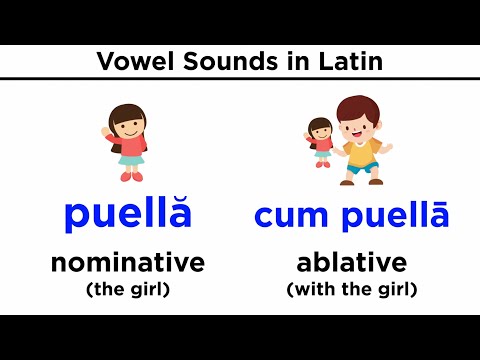
,1,If we are going to learn Latin, the first thing we must do is learn phonetics, as we need to understand the basic sounds of the language, so that we can read it properly. This will require looking at both vowels and consonants, so let's look at vowels first!
Script by Patrizia Farina, Professor of Italian at Western Connecticut State University and Purchase College.
Watch the whole Latin playlist: http://bit.ly/ProfDaveLatin
Italian Tutorials: http://bit.ly/ProfDaveItalian
American History Tutorials: http://bit.ly/ProfDaveAmericanHistory
Philosophy Tutorials: http://bit.ly/ProfDavePhilo
Classical Physics Tutorials: http://bit.ly/ProfDavePhysics1
Modern Physics Tutorials: http://bit.ly/ProfDavePhysics2
General Chemistry Tutorials: http://bit.ly/ProfDaveGenChem
Organic Chemistry Tutorials: http://bit.ly/ProfDaveOrgChem
Biochemistry Tutorials: http://bit.ly/ProfDaveBiochem
Biology Tutorials: http://bit.ly/ProfDaveBio
EMAIL► ProfessorDaveExplains@gmail.com
PATREON► http://patreon.com/ProfessorDaveExplains
Check out "Is This Wi-Fi Organic?", my book on disarming pseudoscience!
Amazon: https://amzn.to/2HtNpVH
Bookshop: https://bit.ly/39cKADM
Barnes and Noble: https://bit.ly/3pUjmrn
Book Depository: http://bit.ly/3aOVDlT