,UN,United Nations,UNGA,UN General Assembly,General Debate,Naciones Unidas,Организация Объединенных Наций,OOH,Nations Unies,联合国,الأمم المتحدة,The Global Goals,Sustainable Development Goals,Human Rights,UN Peacekeepers,Security Council,World Leaders,l'Assemblée générale,Генеральной Ассамблеи,La Asamblea General,13C0KvXN2fo,, Politics,Society, channel_UC5O114-PQNYkurlTg6hekZw, video_13C0KvXN2fo,Noon Briefing by Stéphane Dujarric, Spokesperson for the Secretary-General.
Highlights:
- Global Humanitarian Funding
- Kenya
- Sudan
- South Sudan
- Occupied Palestinian Territory
- Security Council
- International Days
- Guests Today and Tomorrow
GLOBAL HUMANITARIAN FUNDING
The Office for the Coordination of Humanitarian Affairs says that halfway into 2024, just 18 per cent – or $8.8 billion – of the $48.7 billion needed to help people in need around the world this year has been received. This is less than the amount received at the same time last year.
These funding gaps have real consequences for the lives of millions of people, and the UN encourages donors to continue to contribute generously to humanitarian response plans.
OCHA warns that the consequences of this underfunding have been particularly acute in the nine most underfunded crises: Burkina Faso, Cameroon, Chad, the Democratic Republic of the Congo, Haiti, Honduras, Mali, Myanmar and Sudan.
At 1:15pm this afternoon, as part of the Economic and Social Council’s Humanitarian Affairs Segment, there will be an event in Conference Room 7 entitled “Underfunding and the Cost of Inaction: How to address one of the main challenges to humanitarian response.”
KENYA
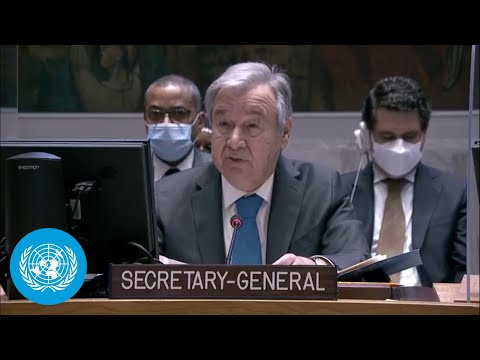
In a statement, the Secretary-General expressed his concerns over the reported violence in Kenya connected to protests and street demonstrations.
He is saddened by the reports of deaths and injuries, including of journalists and medical personnel.
The Secretary-General is also concerned at reported cases of targeted arbitrary detentions.
He underscores the need to uphold the right to demonstrate peacefully. The Secretary-General urges the Kenyan authorities to exercise restraint and calls for all demonstrations to take place peacefully.
The Secretary-General conveys his condolences to the bereaved families and wishes those injured a speedy recovery.
Full Highlights: https://www.un.org/sg/en/content/noon-briefing-highlight?date%5Bvalue%5D%5Bdate%5D=26%20June%202024
,UN,United Nations,UNGA,UN General Assembly,General Debate,Naciones Unidas,Организация Объединенных Наций,OOH,Nations Unies,联合国,الأمم المتحدة,The Global Goals,Sustainable Development Goals,Human Rights,UN Peacekeepers,Security Council,World Leaders,l'Assemblée générale,Генеральной Ассамблеи,La Asamblea General,hIuZtDAtEv4,, Politics,Society, channel_UC5O114-PQNYkurlTg6hekZw, video_hIuZtDAtEv4,Secretary-General António Guterres today launched a set of United Nations Global Principles for Information Integrity that calls for “an information environment that champions human rights and a sustainable future.”
Speaking one year after the launch of his report into information integrity on digital platforms, the Secretary-General put forward a framework for coordinated international action to make information spaces safer and more humane, one of the most urgent tasks of our time.
Misinformation, disinformation, hate speech and other risks to the information ecosystem are fueling conflict, threatening democracy and human rights, and undermining public health and climate action. Their proliferation is now being supercharged by the rapid rise of readily available Artificial Intelligence (AI) technologies, increasing the threat to groups often targeted in information spaces, including children.
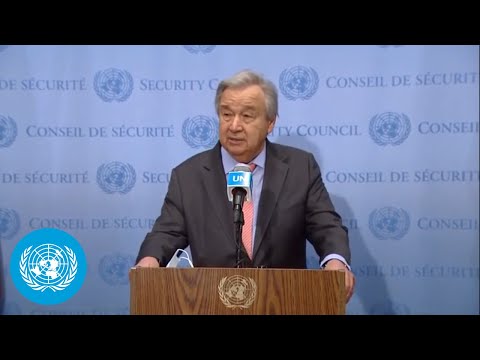
Speaking to reporters today (24 Jun) in New York, Guterres said that the five five principles – societal trust and resilience; independent, free, and pluralistic media; healthy incentives; transparency and research; and public empowerment – are based on an overriding vision of a more humane information ecosystem.
“They provide a solid foundation for sustainable, inclusive development, climate action, democracy, and peace,” he emphasized.
Guterres explained that the United Nations Global Principles for Information Integrity are the result of broad consultations with Member States, youth leaders, academia, civil society, the private sector including tech companies, and the media.
Those consultations showed that much of the world shares our deep concern and is searching for solutions, he said.
The Secretary-General reiterated, “ The Global Principles lay out a clear path forward, firmly rooted in human rights, including the rights to freedom of expression and opinion.”
He urged governments, the tech sector, and other stakeholders to “listen to your people and your customers – and respond.”
Guterres said that he has a clear message - demand action.
“To the big tech companies - take responsibility,” the UN chief went on by saying that “acknowledge the damage your products are inflicting on people and communities. You have the power to mitigate harm to people and societies around the world. You have the power to change business models that profit from disinformation and hate.”
To advertisers and the PR industry, Guterres told them to “stop monetizing harmful content.”
He continued, “Strengthen information integrity; protect your brand; boost your bottom line. The climate crisis is a cause of particular concern. Coordinated disinformation campaigns are seeking to undermine climate action.”
“Creatives - don’t use your talents to greenwash. PR agencies – look for clients who aren’t misleading people and destroying our planet,” the UN chief added.
In his message to media outlets, Guterres said, “Raise and enforce editorial standards. Do your part to safeguard our future by providing quality journalism based on facts and reality. Find advertisers who are part of the solution, not the problem.”
To governments, the UN chief urges them to “commit to creating and maintaining a free, viable, independent, and plural media landscape. Guarantee strong protections for journalists. Ensure regulations uphold human rights. Refrain from drastic measures, including blanket internet shutdowns. Respect the right to freedom of opinion and expression.”
The United Nations Global Principles for Information Integrity stem from a proposal in Our Common Agenda, the Secretary-General’s 2021 report that outlines a vision for future global cooperation and multilateral action.
The Principles provide a resource for Member States ahead of September’s Summit of the Future.
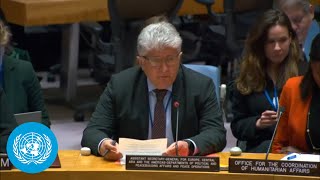
,UN,United Nations,UNGA,UN General Assembly,General Debate,Naciones Unidas,Организация Объединенных Наций,OOH,Nations Unies,联合国,الأمم المتحدة,The Global Goals,Sustainable Development Goals,Human Rights,UN Peacekeepers,Security Council,World Leaders,l'Assemblée générale,Генеральной Ассамблеи,La Asamblea General,ukraine,ukraine war,ukraine news,united nations security council,security council united nations,u3Ya0fw5vXw,, Politics,Society, channel_UC5O114-PQNYkurlTg6hekZw, video_u3Ya0fw5vXw,Security Council briefing by Miroslav Jenča, Assistant Secretary-General for Europe, Central Asia and Americas, Departments of Political and Peacebuilding Affairs and Peace Operations, on Ukraine.
“Russian attacks on Ukrainian cities and towns have become a daily destructive pattern. This includes intense and systematic targeting of Ukrainian energy infrastructure across the country. We are appalled by the increase in civilian casualties as a result of these relentless attacks.”
“In a disturbing reminder of the serious risks posed by this war, on Sunday, Ukraine’s Zaporizhzhia Nuclear Power Plant - Europe’s largest and currently under the military occupation of the Russian Federation - was directly targeted in military action for the first time since November 2022.”
“No one can benefit – neither militarily nor politically – from attacking nuclear facilities. Instead, the consequences of a nuclear accident – whether intentional or not - could be catastrophic to us all.”
,UN,United Nations,UNGA,UN General Assembly,General Debate,Naciones Unidas,Организация Объединенных Наций,OOH,Nations Unies,联合国,الأمم المتحدة,The Global Goals,Sustainable Development Goals,Human Rights,UN Peacekeepers,Security Council,World Leaders,l'Assemblée générale,Генеральной Ассамблеи,La Asamblea General,Urk9tRqN4S0,, Politics,Society, channel_UC5O114-PQNYkurlTg6hekZw, video_Urk9tRqN4S0,Press briefing by António Guterres, UN Secretary-General, on the launch the World of Debt Report from the UN Global Crisis Response Group.
-------------------------
UN Secretary-General António Guterres said that almost half of humanity live in countries that spend more on debt interest payments than on education or health, it is “more than a systemic risk. It is a systemic failure.”
Speaking to reporters, the Secretary-General said that the main message of the report is that half our world is sinking into a development disaster, fuelled by a crushing debt crisis.
He said some of the poorest countries in the world are being forced into a choice between servicing their debt or serving their people,” adding that “they have virtually no fiscal space for essential investments in the Sustainable Development Goals or the transition to renewable energy. Levels of public debt are staggering – and surging.”
Guterres also said that a total of 52 countries – almost 40 percent of the developing world – are in serious debt trouble.
He reiterated, “This is the result of the inequality built into our outdated global financial system, which reflects the colonial power dynamics of the era when it was created.”
The UN chief added, “That system has not fulfilled its mandate as a safety net to help all countries manage today’s cascade of unforeseen shocks – the pandemic; the devastating impact of the climate crisis; and the Russian invasion of Ukraine.”
Guterres concluded that the report sets out a roadmap to global financial stability – including through an effective debt workout mechanism that supports payment suspensions, longer lending terms, and lower rates, including for vulnerable middle-income countries.
,1,2023 is the Halftime of the 2030 Agenda. As Co-Chair of the UN Secretary-General’s SDG Advocates group, Prime Minister of Canada Justin Trudeau sits down with the UN to discuss the continued relevance of the Sustainable Development Goals and renewed ambition for the second half of the 2030 Agenda.
,1,Remarks by António Guterres, United Nations Secretary-General, at the opening of the 2022 High-level Segment of ECOSOC, Ministerial Segment of High-Level Political Forum.
Remarks as delivered:
Our world is in deep trouble – and so too are the Sustainable Development Goals.
Time is running out.
But there is still hope.
Because we know what we need to do:
End the senseless, disastrous wars – now.
Unleash a renewable energy revolution – now.
Invest in people and build a new social contract – now.
And deliver a New Global Deal to rebalance power and financial resources and enable all developing countries to invest in the SDGs.
Let’s come together, starting today, with ambition, resolve and solidarity, to rescue the SDGs before it is too late.
Excellencies,
We meet at a time of great uncertainty.
The world faces cascading crises that are causing profound suffering today, and carry the seeds of dangerous inequality, instability and climate chaos tomorrow.
The ripple effects of Russia’s invasion of Ukraine have hit amid a fragile and uneven recovery from the COVID-19 pandemic, while the climate emergency is gathering pace.
Some countries are investing in recovery through a transition to renewable energy and sustainable development.
But others are unable to do so, because of deep-rooted structural challenges and inequalities, at global and national levels.
Some 94 countries, home to 1.6 billion people, face a perfect storm: dramatic increases in the price of food and energy, and a lack of access to finance.
And so there is a real risk of multiple famines this year.
Next year could be even worse, if fertilizer shortages affect the harvests of staple crops, including rice.
The United Nations Global Crisis Response Group on Food, Energy and Finance has warned of the impacts of the current cost of living crisis and the future risks for next year :
Sixty per cent of workers today have lower real incomes than before the pandemic;
Developing countries are missing $1.2 trillion per year, just to fill the social protection gap;
And sixty percent of developing economies are currently in, or at high risk of, debt distress.
Meanwhile, the number of people forced from their homes has risen to 100 million -- the highest number since the creation of the United Nations.
The planet’s largest ecosystems – oceans and forests - are in danger. Biodiversity is declining at unprecedented rates.
Discrimination against women and girls continues in all sectors and all societies, while gender-based violence is at emergency levels. Attacks on women’s reproductive rights are reverberating around the world.
Implementing the Sustainable Development Goals will require $4.3 trillion USD per year -- more money than ever before -- because the international community is simply not keeping pace with the commitments it made;
Excellencies,
In the face of these cascading crises, we are far from powerless.
There is much we can do, and many concrete steps we can take, to turn things around.
I see four areas for immediate action.
First, recovery from the pandemic in every country.
We must ensure equitable global access to COVID-19 vaccines, therapies and tests. And now it is very important to have a serious effort to increase the number of countries that can produce vaccines, diagnostics, and other else technologies thinking about the future.
Governments must work together with the pharmaceutical industry and other stakeholders to share licenses and to provide technical and financial support to allow many other countries to produce vaccines and other medical important products.
Then we must redouble our efforts to make sure future outbreaks of disease are better managed by strengthening health systems and ensuring Universal Health Coverage.
Second, we need to tackle the food, energy and finance crisis.
Ukraine's food production, and the food and fertilizer produced by Russia, must be brought back to world markets -- despite the war.
We have been working hard on a plan to allow for the safe and secure exports of Ukrainian produced foods through the Black Sea and Russian foods and fertilizers to global markets.
I thank the governments involved for your continued cooperation.
But there can be no solution to today’s crises without a solution to the crisis of economic inequality in the developing world.
We need to make resources and fiscal space available to countries and communities, including Middle Income Countries, that have an even more limited financial toolbox than three years ago.
This requires global financial institutions to use all the instruments at their disposal, with flexibility and understanding.
Full remarks: https://www.un.org/sg/en/content/sg/statement/2022-07-13/secretary-generals-remarks-the-opening-of-the-2022-high-level-segment-of-ecosoc-ministerial-segment-of-high-level-political-forum-delivered
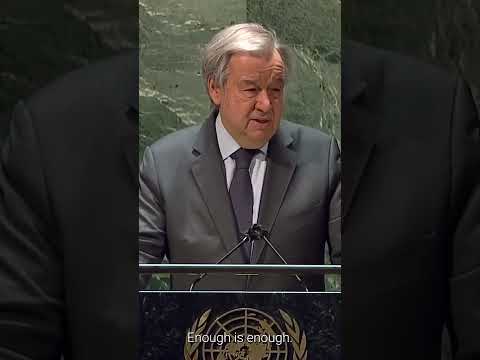
,1,Today, I apologize to young people on behalf of my generation for the fact that we have not protected the oceans. And my generation until now has failed in responding effectively to this. This Conference is very important to reverse the trend. I count a lot on young people's strength, dynamism and their intervention in order to make sure that we are able to reverse the trend.
#shorts #SaveOurOcean
,1,Video Message by António Guterres, Secretary-General of the United Nations, to the International Romani Union 2022.
Today, we celebrate the rich history of the Roma, Sinti and Travellers.
We recognize their contributions to societies everywhere.
And we reflect on the human rights situation of Roma worldwide.
Roma continue to confront centuries-old prejudice, discrimination, and marginalization.
I am particularly concerned about the alarming rise of hate speech and scapegoating of the Roma by right-wing extremist and xenophobic groups.
The United Nations is fully committed to working with Roma civil society and others to speak out against anti-Gypsyism and stand up for Roma inclusion and human rights.
I remind all governments of their responsibility to provide full and equal access to education, employment, housing, health care, and public services to all their people without discrimination based on race, religion or ethnicity.
Roma fleeing persecution and conflict – most immediately today from Ukraine – have the same rights and must be extended the same solidarity as other refugees.
On this International Roma Day, let us rededicate ourselves to the promotion of equality, dignity, and non-discrimination for all.
,UN,United Nations,8Ugx1hClQdU,, Politics,Society, channel_UC5O114-PQNYkurlTg6hekZw, video_8Ugx1hClQdU,Informal comments to the media by Sergiy Kyslytsya, Permanent Representative of Ukraine to the United Nations, on the General Assembly vote to suspend Russia from the Human Rights Council at the General Assembly Media Stakeout.
,1,Briefing by António Guterres, United Nations Secretary-General, on Ukraine.
"(...) The war in Ukraine is one of the greatest challenges ever to the international order and the global peace architecture, founded on the United Nations Charter.
Because of its nature, intensity, and consequences.
We are dealing with the full-fledged invasion, on several fronts, of one Member State of the United Nations, Ukraine, by another, the Russian Federation – a Permanent Member of the Security Council – in violation of the United Nations Charter, and with several aims, including redrawing the internationally-recognized borders between the two countries.
The war has led to senseless loss of life, massive devastation in urban centres, and the destruction of civilian infrastructure.
I will never forget the horrifying images of civilians killed in Bucha.
I immediately called for an independent investigation to guarantee effective accountability.
I am also deeply shocked by the personal testimony of rapes and sexual violence that are now emerging.
The High Commissioner for Human Rights has spoken of possible war crimes, grave breaches of international humanitarian law and serious violations of international human rights law.
The war has displaced more than ten million people in just one month –
the fastest forced population movement since the Second World War.
Far beyond Ukraine’s borders, the war has led to massive increases in the prices of food, energy and fertilizers, because Russia and Ukraine are lynchpins of these markets.
It has disrupted supply chains, and increased the cost of transportation, putting even more pressure on the developing world.
Many developing countries were already on the verge of debt collapse, due to the impact of the Covid-19 pandemic and a lack of adequate liquidity and debt relief, stemming ultimately from the unfair nature of our global economic and financial system.
For all these reasons, it is more urgent by the day to silence the guns.
That is why I asked the Emergency Relief Coordinator, Martin Griffiths, to travel to Russia and Ukraine to press for an urgent humanitarian ceasefire.
Under-Secretary-General Griffiths will update you on the humanitarian situation and the results of his contacts so far.
Under-Secretary-General DiCarlo will also brief you on the poitical dimensions.
But as Secretary-General of the United Nations, it is my duty to call the attention of the Council to the serious damage being done to the global economy, and particularly to vulnerable people and developing countries.
Madame President,
Our analysis indicates that 74 developing countries, with a total population of 1.2 billion people, are particularly vulnerable to spiking food, energy and fertilizer costs.
Debt obligations take up some 16 percent of developing countries’ export earnings. In small island developing states, the figure is 34 percent and rising, because of increased interest rates and the need to pay for expensive imports.
In the past month alone, wheat prices have increased by 22 percent, maize by 21 percent and barley by 31 percent.
Brent oil prices on 1 April were more than 60 percent higher than at the same time last year. A series of events have led to that not only the present situation.
Natural gas and fertilizer prices more than doubled over the same period.
We are already seeing some countries move from vulnerability into crisis, and signs of serious social unrest.
The flames of conflict are fueled by inequality, deprivation and underfunding.
With all the warning signals flashing red, we have a duty to act.
Madame President,
The Global Crisis Response Group on food, energy and finance that I set up last month has formulated some initial recommendations for the consideration of Member States, International Financial Institutions and others.
On food, we are urging all countries to keep markets open, resist unjustified and unnecessary export restrictions, and make reserves available to countries at risk of hunger and famine. This is not the time for protectionism.
Humanitarian appeals must be fully funded.
People caught up in crisis around the world cannot pay the price for this war.
On energy: the use of strategic stockpiles and additional reserves could help to ease this energy crisis in the short term.
But the only medium- and long-term solution is to accelerate the deployment of renewable energy, which is not impacted by market fluctuations (...)". [Excerpt]
Full remarks [as delivered]: https://www.un.org/sg/en/node/262883
,1,Opening remarks by António Guterres, Secretary-General of the UN, at the Eleventh Emergency Special Session on Ukraine.
----
The United Nations is an international organization founded in 1945. Currently made up of 193 Member States, the UN and its work are guided by the purposes and principles contained in its founding Charter.
The UN has evolved over the years to keep pace with a rapidly changing world.
But one thing has stayed the same: it remains the one place on Earth where all the world’s nations can gather together, discuss common problems, and find shared solutions that benefit all of humanity.
#UnitedNations #UN #Shorts
,1,Media Stakeout by António Guterres, United Nations Secretary-General, on Ukraine.
Secretary-General António Guterres today (14 Feb) told reporters he had spoken to the ministers of foreign affairs of the Russian Federation and Ukraine and said, “the time is now to defuse tensions and de-escalate actions on the ground.”
The Secretary-General said he was “deeply worried by the heightened tensions and increased speculation about a potential military conflict in Europe,” and added, “we simply cannot accept even the possibility of such a disastrous confrontation.”
He said, “there is no alternative to diplomacy” and noted that “the United Nations Country Team remains fully operational in Ukraine.”
Quoting from the United Nations Charter, Guterres said, “all Members shall settle their international disputes by peaceful means in such a manner that international peace and security, and justice, are not endangered,” and “all Members shall refrain in their international relations from the threat or use of force against the territorial integrity or political independence of any state, or in any other manner inconsistent with the Purposes of the United Nations.”
The Secretary-General welcomed “the recent flurry of diplomatic contacts and engagements, including between Heads of State.” but stressed that “more needs to be done.”
Abandoning diplomacy for confrontation, he said, “is not a step over a line, it is a dive over a cliff.”
————-
"Good afternoon.
I am deeply worried by the heightened tensions and increased speculation about a potential military conflict in Europe.
The price in human suffering, destruction and damage to European and global security is too high to contemplate.
We simply cannot accept even the possibility of such a disastrous confrontation.
I will remain fully engaged in the hours and days to come.
I just spoke this morning with the Ministers of Foreign Affairs of the Russian Federation and of Ukraine.
My message is clear: There is no alternative to diplomacy.
All issues – including the most intractable – can and must be addressed and resolved through diplomatic frameworks. It is my firm belief that this principle will prevail.
The United Nations Country Team remains fully operational in Ukraine.
As United Nations Secretary-General, it is my duty to appeal for the full respect of the United Nations Charter, a fundamental pillar of international law.
The Charter clearly says, and I quote:
“All Members shall settle their international disputes by peaceful means in such a manner that international peace and security, and justice, are not endangered.”
“All Members shall refrain in their international relations from the threat or use of force against the territorial integrity or political independence of any state, or in any other manner inconsistent with the Purposes of the United Nations.”
The time is now to defuse tensions and de-escalate actions on the ground.
There is no place for incendiary rhetoric. Public statements should aim to reduce tensions, not inflame them.
I welcome the recent flurry of diplomatic contacts and engagements, including between Heads of State.
But more needs to be done, and I expect all to intensify their efforts.
I have made my good offices available and we will leave no stone unturned in the search for a peaceful solution.
Abandoning diplomacy for confrontation is not a step over a line, it is a dive over a cliff.
In short, my appeal is this: Do not fail the cause of peace.
Thank you".
,UN,United Nations,MKX-YxjJWqI,, Politics,Society, channel_UC5O114-PQNYkurlTg6hekZw, video_MKX-YxjJWqI,Video Message by António Guterres, Secretary-General of the United Nations, on World Food Day 2021.
World Food Day is not only a reminder of the importance of food to every person on the planet — it is a call to action to achieve food security around the world.
Today, almost 40 per cent of humanity — three billion people — cannot afford a healthy diet.
Hunger is on the rise.
So too are undernourishment and obesity.
The economic impacts of COVID-19 have made a bad situation even worse.
The pandemic has left an additional 140 million people unable to access the food they need.
At the same time, the way we produce, consume and waste food is taking a heavy toll on our planet.
It is putting historic pressure on our natural resources, climate and natural environment — and costing us trillions of dollars a year.
As this year’s theme makes clear, the power to change is in our hands.
“Our actions are our future.”
Last month, the world gathered for the United Nations Food Systems Summit.
Countries made bold commitments to transform food systems.
To make healthy diets more affordable and accessible.
And to make food systems more efficient, resilient and sustainable at every step — from production and processing, to marketing, transportation and delivery.
We can all change how we consume food, and make healthier choices — for ourselves, and our planet.
In our food systems, there is hope.
On this World Food Day, join us as we commit to take transformative action to deliver on the Sustainable Development Goals through food systems that deliver better nutrition, a better environment and a better life for every person.
,UN,United Nations,BEOcTLyMxVA,, Society, channel_UC5O114-PQNYkurlTg6hekZw, video_BEOcTLyMxVA,BTS, the Korean band, were a sensation when they appeared at the United Nations Headquarters as the Republic of Korea’s Special Presidential Envoys for Future Generations and Culture.
BTS members RM, Jin, Suga, j-hope, Jimin, V and Jungkook participated in the UN’s SDG Moment, designed to call attention to the Sustainable Development Goals.
They seized the opportunity to remind everyone of the importance of vaccinating against COVID-19.
#Shorts #BTS
,english,food,global issues,secretary-general,topics/issues,6199989971001,6wPrjNA2T_Y,, Politics,Society, channel_UC5O114-PQNYkurlTg6hekZw, video_6wPrjNA2T_Y,The systems that bring food to our tables have a profound impact on our economies, our health and the environment.
Food systems are one of the main reasons we are failing to stay within our planet’s ecological boundaries.
But they can also be the key to tackling the climate crisis, addressing soaring biodiversity loss and healthier societies.
This year, the COVID-19 pandemic has highlighted the fragility of our food systems.
Millions more people are hungry, and millions of jobs have been lost.
Meanwhile, the climate emergency continues apace.
To address these issues, I am convening a Food Systems Summit next year.
This will be a ‘People’s Summit’ and a ‘Solutions Summit’.
This action-oriented conversation will come together in two key moments.
The first will be a pre-Summit meeting in Rome in summer next year.
This meeting will build on inclusive country and regional dialogues and will define bold actions for inclusive and sustainable food systems.
The second, will be the Food Systems Summit itself, and will bring the attention of all world leaders to this issue.
We need global engagement and action for inclusive and sustainable food systems.
I urge you to join the conversation.
,1,The United Nations Secretary-General António Guterres held his annual press conference at the opening of the 75th Session of the General Assembly. He noted that the COVID-19 virus is the number one global security threat in our world today, stressing the need for the global ceasefire that he called for in March to become a reality by the end of the year.
The Secretary-General also underlined the need for the international community needs to come together to defeat the virus, calling for the massive expansion of new and existing tools that can respond to new cases and provide vital treatment to suppress transmission and save lives, especially over the next 12 months. A vaccine, he said, must be seen as a global public good, because COVID-19 respects no borders.
Full remarks: https://www.un.org/sg/en/content/sg/press-encounter/2020-09-16/secretary-generals-press-conference-the-opening-of-the-75th-session-of-the-general-assembly
——-
Speaking to reporters on Wednesday (16 Sep) in New York, on the eve of the 75th General Debate scheduled to start the next week, Guterres said “the COVID-19 pandemic is a crisis unlike any in our lifetimes, and so this year’s General Assembly session will be unlike any other, too. “
“We have a full programme and the stakes could not be higher,” the Secretary-General said. “Our world is nearing the grimmest of milestones: one million lives lost to the virus. Meanwhile, the outbreak remains out of control.”
Calling the coronavirus “the number one global security threat in our world today,” Guterres said was why in March this year he called for a global ceasefire.
“My appeal resonated with Member States, civil society and a number of armed groups across the world,” he said. “And today, from Afghanistan to Sudan, we see hopeful new steps toward peace. In Syria, Libya, Ukraine and elsewhere, ceasefires or standstills in the fighting can create space for diplomacy. In Yemen, we are pressing for a ceasefire, confidence building measures and resumption of the political process.”
The Secretary-General called for the international community to come together to defeat the virus by “massively expand new and existing tools that can respond to new cases and provide vital treatment to suppress transmission and save lives, especially over the next 12 months.”
He said “many pin their hopes on a vaccine – but let’s be clear: there is no panacea in a pandemic. A vaccine alone cannot solve this crisis; certainly not in the near term.”
Guterres also called for a vaccine to be seen “as a global public good, because COVID-19 respects no borders. We need a vaccine to be affordable and available to all – a people’s vaccine.”
The Secretary-General warned against what he called a proliferation of misinformation about a future vaccine.
“Mistrust in vaccines is on the rise around the world. We have seen alarming reports of large segments of the population in some countries indicating their reluctance or even refusal to take a future COVID-19 vaccine. In the face of this lethal disease, we must do our utmost to halt deadly misinformation,” he said.
Economic recovery in the aftermath of the pandemic, is the world’s chance to put itself back on track in achieving the Sustainable Development Goals, according to Guterres.
“Even before the pandemic, the world was veering far off course in efforts to eradicate poverty, achieve the Sustainable Development Goals, and we were losing the battle against climate change,” Guterres said. “Greenhouse gas concentrations reached new record highs in 2020. The Northern Hemisphere has just experienced its hottest summer on record. The world is burning, and recovery is our chance to get on track and tame the flames.”
“Recovery must be aligned with the Sustainable Development Goals and the Paris Agreement on Climate Change. Recovery must be green. Subsidizing fossil fuels and bailing out polluting industries means locking in bad patterns for decades to come. Recovery must advance gender equality. And recovery requires effective multilateralism,” he said.
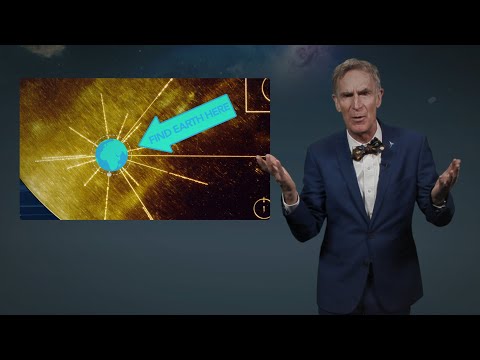
,1,The Voyager Golden Record shot into space in 1977 with a message from humanity to the cosmos – and decades later, it stands as a reminder that we are all connected.
The United Nations displays a replica of the Golden Record at its Headquarters, and shares a deep connection to the process of creating it. A NASA committee asked the UN to provide materials to include on the playlist, and the first words on the Record itself are those of the then-UN Secretary-General expressing hope for peace and friendship with whoever discovers and plays it.
Bill Nye “The Science Guy,” CEO of the Planetary Society, walks viewers through how to decipher the Golden Record, its significance today, and how reverence for the universe can inspire action for our planet.
This aligns with the ongoing work of the United Nations to promote international cooperation in the peaceful use and exploration of space.
The Director of the UN Office for Outer Space Affairs, Simonetta Di Pippo, explains the significance of the Golden Record in our world now. “The undertaking of the Voyager project reminds us of who we are, where we came from, and that we should treat each other with care.”
,1,Join us LIVE for the Press Conference by United Nations Secretary-General Mr. António Guterres to mark the opening of the 74th session of the UN General Assembly.
,dpiavl,english,topics/issues,security council,6075864703001,V9htWwgb5ic,, Politics,Society, channel_UC5O114-PQNYkurlTg6hekZw, video_V9htWwgb5ic,Remarks by Izumi Nakamitsu, Under Secretary-General for Disarmament Affairs, on threats to International Peace and Security during the 8602nd meeting of the Security Council.
Addressing a Security Council briefing on the 18 August intermediate-range cruise missile test conducted by the US, Under-Secretary-General for Disarmament Affairs Izumi Nakamitsu today (22 Aug) said the recent collapse of the Intermediate Nuclear Forces Treaty (INF) “removed one of the few constraints on the development and deployment of a destabilizing and dangerous classes of missiles.”
Nakamitsu stressed “the INF Treaty’s ending should not be the catalyst for renewed and unconstrained competition in missile development, acquisition and proliferation.”
The disarmament official said, “preventing the spread and emergence of destabilizing weapons remains a vital unfinished task for the international community in our shared endeavor to preserve international peace, security and stability.”
,daily news story,news & features,GyFt1l21oX8,, Politics,Society, channel_UC5O114-PQNYkurlTg6hekZw, video_GyFt1l21oX8,The United Nations has concluded a two-week High-Level Political Forum to take stock of the global efforts to reach the 2030 Sustainable Development Goals.
See highlights in this short video.
More info: https://sustainabledevelopment.un.org/hlpf/2019
,UN,United Nations,climate change,Caribbean,IAEA,nuclear science,PorTumvpJhk,, Society, channel_UC5O114-PQNYkurlTg6hekZw, video_PorTumvpJhk,When it comes to climate change, the islands of the Caribbean are particularly under threat. Representatives from ten Caribbean countries are at the IAEA headquarters in Vienna to discuss the use of nuclear science and technology in dealing with this problem.
,1,The Sustainable Development Goals (SDGs), are a universal call to action to end poverty, protect the planet and ensure that all people enjoy peace and prosperity.
Read more on https://www.un.org/sustainabledevelopment/
,UN,United Nations,Police,United Nations police,peacekeeping,United Nations peacekeeping,rule of law,Mali,OoxX0bkxQu8,, Politics,Society, channel_UC5O114-PQNYkurlTg6hekZw, video_OoxX0bkxQu8,United Nations - Police Commissioner Issoufou Yacouba explains the policing mandate of the United Nations Multidimensional Integrated Stabilization Mission in Mali (MINUSMA). Based on the mandate, United Nations police supports the restoration and extension of state authority throughout the territory of Mali. This includes, the protection of civilians through patrols, escorts and deterring crime, as well as support to the Malian security forces. The police component in MINUSMA further supports the handling of free and fair elections and the reform of the Malian security forces, including gender mainstreaming in the gendarmerie and national guard.
The main challenges of the police component include the direct attacks of UN personnel and property as well as the difficulty of intelligence gathering to prevent, respond and address criminal activity in Mali.
United Nations police are deployed in 11 peacekeeping operations, as well as 6 Special Political Missions to help restore confidence in host-State police and rule of law structures and serving to protect civilians, providing electoral and border security and management, limiting the effects of transnational organised crime, investigating and preventing cases of sexual and gender-based violence. Over 12,000 UN police officers from 90 countries serve the United Nations as individual police officers (IPOs), in formed police units (FPUs) or as United Nations staff (P-staff).
For more information, visit: www.un.org/police
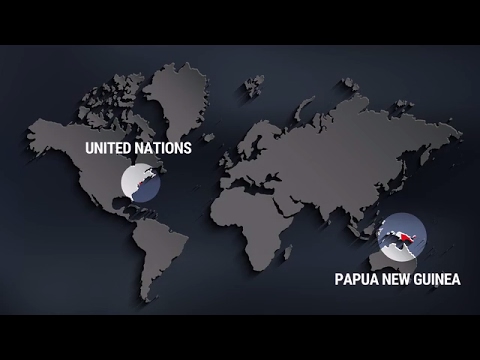
,1,United Nations - In 2015, 193 states, including Papua New Guinea, adopted a set of goals to end poverty, protect the planet, as well as to build prosperity and peace. These Sustainable Development Goals or SDGs serve as a platform to transform the world by 2030. The SDGs aim to improve the quality of each person’s life, because everyone matters.
This film tells the stories of three families in the Coastal, Highlands and Central regions of Papua New Guinea. It documents the challenges the families face in their daily lives, how they are overcoming these and their aspirations for the future.
,1,The 2030 Sustainable Development Agenda makes clear there cannot be development without peace and security. And disarmament is integral to achieving peace and security. Secretary General Ban Ki-moon has said, “The world is overarmed and peace is underfunded.”
An overarmed world is an unstable and insecure one. Disarmament is critical to creating a safer, more prosperous, more equitable and more peaceful world.
,1,Ahead of the 47th Session of the UN Statistical Commission on 8-11 March, Assistant Secretary-General for Economic Development Lenni Montiel, Director of UN DESA’s Statistics Division Stefan Schweinfest, and Chief of the Statistical Service Branch in UN DESA’s Statistics Division Francesca Perucci discuss the development of indicators for the implementation of the Sustainable Development Goals.
For more information on the 47th Session of the United Nations Statistical Commission, visit: http://unstats.un.org/unsd/statcom/
,1,The international community is counting down to a historic moment on 25 September. Over 150 world leaders will gather for the UN Summit on Sustainable Development at UN Headquarters in New York to commit to 17 sustainable development goals (SDGs) that aim to end poverty, fight inequalities and tackle climate change in the next 15 years. Leading up to this major event, the efforts of UN DESA have played a key role.
,UN,United Nations,water,sanitation,Sustainable Development Goals,SDG,DPI,LCKsU4bPFOQ,, Knowledge, channel_UC5O114-PQNYkurlTg6hekZw, video_LCKsU4bPFOQ,United Nations - What makes it so difficult for some people to have access to water? Why are there millions of people in the world without access to a toilet? Does this issue only affect developing countries? Water and Sanitation Expert Leanne Burney from UN DESA answers all these questions on Goal #6.
Find out more about water and sanitation at http://www.un.org/sustainabledevelopment/water-and-sanitation/.
For a list of all the goals see: http://ow.ly/Sj391
Produced by the Department of Public Information
,1,United Nations - In 2015, the world will adopt a new set of goals for the next fifteen years of sustainable development. In designing and implementing the post-2015 agenda, with sustainable development at its core, it is important to fully understand and account for the demographic changes that are likely to unfold in the future.
Through a deeper understanding of how the world is changing, combined with better planning, stronger partnerships, and greater political will, we can create a better tomorrow for both people and planet," said Mr. John Wilmoth, Director of UN DESA’s Population Division, as his division prepares for the upcoming 48th session of the Commission on Population and Development, which will take place at UN Headquarters in New York on 13-17 April.
Follow #CPD48 and #UNPopulation on Twitter for updates!
Read the feature article in DESA News: http://www.un.org/en/development/desa/newsletter/desanews/feature/2015/04/index.html#14262
For more information: http://www.un.org/en/development/desa/population/commission/sessions/2015/index.shtml