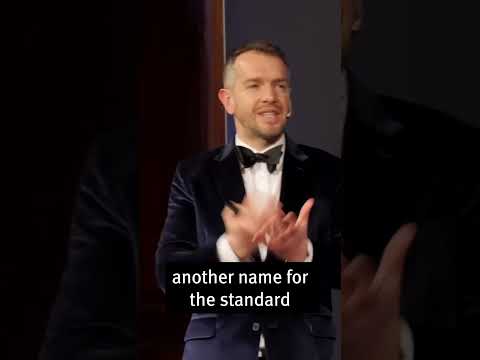
Can we trust stories about the future? Join historian and bestselling author David Christian as he offers an introduction to the strange world of the future.
Join this channel to get access to perks:
https://www.youtube.com/channel/UCYeF244yNGuFefuFKqxIAXw/join
Subscribe for regular science videos: http://bit.ly/RiSubscRibe
This lecture was recorded at the Ri on 20 November 2023.
Every second of our lives - whether we're looking both ways before crossing the street, celebrating the birth of a baby, or moving to a new city - we must cope with an unknowable future by telling stories about what will happen next.
What we think we know about it at all scales, from the predictive mechanisms of single-celled organisms and tomato plants to the merging of colossal galaxies billions of years from now. Drawing together science, history and philosophy from a huge range of places and times, David will explore how we prepare for uncertain futures, including the future of human evolution, artificial intelligence, interstellar travel, and more.
For all those curious about what the world could look like in the next hundred years and what the solutions to the biggest challenges facing us all could look like, this is an unmissable event.
---
David Christian is a Professor Emeritus at Macquarie University, where he was formerly a Distinguished Professor of History and the director of the Big History Institute. He cofounded the Big History Project with Bill Gates, his Coursera MOOCs are popular around the world, and he is cocreator of the Macquarie University Big History School.
He has delivered keynotes at conferences around the world, including the Davos World Economic Forum, and his TED Talk has been viewed more than twelve million times. He is the author of numerous books and articles, as well as the New York Times bestseller Origin Story.
---
The Ri is on Twitter: http://twitter.com/ri_science
and Facebook: http://www.facebook.com/royalinstitution
and TikTok: https://www.tiktok.com/@ri_science
Listen to the Ri podcast: https://podcasters.spotify.com/pod/show/ri-science-podcast
Donate to the RI and help us bring you more lectures: https://www.rigb.org/support-us/donate-ri
Our editorial policy: https://www.rigb.org/editing-ri-talks-and-moderating-comments
Subscribe for the latest science videos: http://bit.ly/RiNewsletter
Product links on this page may be affiliate links which means it won't cost you any extra but we may earn a small commission if you decide to purchase through the link.
,1,2025 is the International Year of Quantum Science and Technology, as marked by the UN, to celebrate 100 years since the birth of quantum mechanics. But quantum science is one of the least diverse areas of science in terms of gender and other protected characteristics.
Jess Wade, a physicist and lecturer in functional materials at Imperial College London, has been fighting the inequality in quantum physics and beyond by creating thousands of Wikipedia pages for women scientists. Jess joins us this month to discuss the past, present, and future of quantum science along with what can be done to increase diversity within the field.
Ri Science Podcast episodes are released on the last Wednesday of every month. Subscribe wherever you get your podcasts to be notified as soon as episodes are released!
---
Jess Wade is a British physicist in the Blackett Laboratory at Imperial College London, specialising in Raman spectroscopy. Her research investigates polymer-based organic light emitting diodes (OLEDs). Her public engagement work in science, technology, engineering, and mathematics (STEM) advocates for women in physics as well as tackling systemic biases such as gender and racial bias on Wikipedia. Read more about here here: https://en.wikipedia.org/wiki/Jess_Wade
---
Producer: Lia Hale
Assistant producers: Katie Mortimer, Isla Nakano
Interviewer: Lia Hale
Music: Joseph Sandy
--
Join this channel to get access to perks:
https://www.youtube.com/channel/UCYeF244yNGuFefuFKqxIAXw/join
Subscribe for regular science videos: http://bit.ly/RiSubscRibe
The Ri is on Twitter: http://twitter.com/ri_science
and Facebook: http://www.facebook.com/royalinstitution
and TikTok: https://www.tiktok.com/@ri_science
Listen to the Ri podcast: https://podcasters.spotify.com/pod/show/ri-science-podcast
Donate to the RI and help us bring you more lectures: https://www.rigb.org/support-us/donate-ri
Our editorial policy: https://www.rigb.org/editing-ri-talks-and-moderating-comments
Subscribe for the latest science videos: http://bit.ly/RiNewsletter
Product links on this page may be affiliate links which means it won't cost you any extra but we may earn a small commission if you decide to purchase through the link.
,1,Join this channel to get access to perks:
https://www.youtube.com/channel/UCYeF244yNGuFefuFKqxIAXw/join
Subscribe for regular science videos: http://bit.ly/RiSubscRibe
The Ri is on Twitter: http://twitter.com/ri_science
and Facebook: http://www.facebook.com/royalinstitution
and TikTok: https://www.tiktok.com/@ri_science
Listen to the Ri podcast: https://podcasters.spotify.com/pod/show/ri-science-podcast
Donate to the RI and help us bring you more lectures: https://www.rigb.org/support-us/donate-ri
Our editorial policy: https://www.rigb.org/editing-ri-talks-and-moderating-comments
Subscribe for the latest science videos: http://bit.ly/RiNewsletter
Product links on this page may be affiliate links which means it won't cost you any extra but we may earn a small commission if you decide to purchase through the link.
,1,In the first of his CHRISTMAS LECTURES, Richard Dawkins explores the origins of life. Beginning with a look at our ancestry, he shows how the probability of our existence is very small.
Watch all the lectures in this series here: https://www.youtube.com/playlist?list=PLbnrZHfNEDZwJw3_jDeusmHuVYDdKRpo9
Watch our newest Christmas lectures here: https://www.youtube.com/playlist?list=PLbnrZHfNEDZyQJZLPMjwEoOLdkFBLU2m1
This lecture was filmed at the Ri on 1 December 1991.
These lectures were originally a YouTube member exclusive for our Science Supporters, and now we’re putting them out for everyone to watch. If you can’t wait for them all to be published, get access now by signing up as a YouTube channel member, and help us bring science to more people: https://www.youtube.com/channel/UCYeF244yNGuFefuFKqxIAXw/join
---
Life grows up in the universe by gradual degrees of evolution. Billions of years ago, there existed a vast population of bacteria. But it was only an elite group of these bacteria that evolved to become humans. In truth, we are lucky to be alive.
In the first of his CHRISTMAS LECTURES, Richard Dawkins explores the origins of life. Beginning with a look at our ancestry, he shows how the probability of our existence is very small. Becoming an ancestor is much more difficult than simple reproduction, and Richard reveals how our ancestors did what it took to survive and pass on their genes.
But although some of our life must be devoted to perpetuating it, surely there must be more to it? Richard explores the role of art and culture in society, and examines how the capabilities of the human body have enabled us to accomplish complex tasks.
When it comes to our understanding of the meaning of life, science is important. As Richard explains, science can help us uncover both when we arrived on this planet, and why we are here. Some people turn to the supernatural for the answer to such questions. Richard looks at the limitations of beliefs in the supernatural and uses a cannonball to prove why instead we should have faith in science and its predictions.
--
About the 1991 CHRISTMAS LECTURES
The world-famous evolutionary biologist Richard Dawkins presents the CHRISTMAS LECTURES on "our own growing knowledge of how life grows up in the universe."
Just as children grow up to be adults, so too does life gradually evolve on a planet over thousands of generations, to move from “nonliving simplicity” to become “living complexity”.
Combining beautiful writing with a range of illuminating demonstrations, the series featured a variety of wildlife, a virtual reality Lecture Theatre, and special guests – including the late Douglas Adams reading an excerpt from The Hitchhiker's Guide to the Galaxy.
Find out more about the Ri CHRISTMAS LECTURES here: https://www.rigb.org/christmas-lectures
---
Join this channel to get access to perks:
https://www.youtube.com/channel/UCYeF244yNGuFefuFKqxIAXw/join
Subscribe for regular science videos: http://bit.ly/RiSubscRibe
The Ri is on Twitter: http://twitter.com/ri_science
and Facebook: http://www.facebook.com/royalinstitution
and TikTok: https://www.tiktok.com/@ri_science
Listen to the Ri podcast: https://podcasters.spotify.com/pod/show/ri-science-podcast
Donate to the RI and help us bring you more lectures: https://www.rigb.org/support-us/donate-ri
Our editorial policy: https://www.rigb.org/editing-ri-talks-and-moderating-comments
Subscribe for the latest science videos: http://bit.ly/RiNewsletter
Product links on this page may be affiliate links which means it won't cost you any extra but we may earn a small commission if you decide to purchase through the link.
,1,Watch the Q&A for Sean Carroll's lecture on Einstein's equation explaining spacetime. You can watch the original lecture here: https://youtu.be/BRudidBcfXk
The original lecture and this Q&A were recorded at the Ri on Monday 14 August 2023.
Our lecture Q&As are usually a perk for our YouTube Science Supporters, as a thank you for helping us bring science to more people, but we're publishing this one for everyone as Sean's talk has been so popular.
A huge thank you to our YouTube members for helping us to bring you more science. You can join them here: https://www.youtube.com/channel/UCYeF244yNGuFefuFKqxIAXw/join
Subscribe for regular science videos: http://bit.ly/RiSubscRibe
The Ri is on Twitter: http://twitter.com/ri_science
and Facebook: http://www.facebook.com/royalinstitution
and TikTok: https://www.tiktok.com/@ri_science
Listen to the Ri podcast: https://podcasters.spotify.com/pod/show/ri-science-podcast
Our editorial policy: https://www.rigb.org/editing-ri-talks-and-moderating-comments
Subscribe for the latest science videos: http://bit.ly/RiNewsletter
Product links on this page may be affiliate links which means it won't cost you any extra but we may earn a small commission if you decide to purchase through the link.
,1,Join this channel to get access to perks:
https://www.youtube.com/channel/UCYeF244yNGuFefuFKqxIAXw/join
Subscribe for regular science videos: http://bit.ly/RiSubscRibe
The Ri is on Twitter: http://twitter.com/ri_science
and Facebook: http://www.facebook.com/royalinstitution
and TikTok: https://www.tiktok.com/@ri_science
Listen to the Ri podcast: https://podcasters.spotify.com/pod/show/ri-science-podcast
Donate to the RI and help us bring you more lectures: https://www.rigb.org/support-us/donate-ri
Our editorial policy: https://www.rigb.org/editing-ri-talks-and-moderating-comments
Subscribe for the latest science videos: http://bit.ly/RiNewsletter
Product links on this page may be affiliate links which means it won't cost you any extra but we may earn a small commission if you decide to purchase through the link.
,1,With Britain no longer standing alone against Hitler, the initial contingent of G.l.s landed in the UK, seizing the opportunity created by the Japanese surprise assault on Pearl Harbor. Witnessing the fall of Singapore, the Allies recoiled in dismay as Japan extended its dominion over Java, Burma, and New Guinea, steadily advancing towards Australia.
Produced and narrated by Liam Dale
,1,Workers at Volkswagen have launched rolling strikes in an escalating dispute at one of Germany's biggest employers. Their union IG Metall called the action in protest against planned wage cuts and possible factory closures. The car-maker says it's being hit by spiralling manufacturing costs and stiff competition from China - despite paying out billions of euros in dividends.
For more news go to: http://www.dw.com/en/
Follow DW on social media:
►Instagram: https://www.instagram.com/dwnews
►TikTok: https://www.tiktok.com/@dwnews
►Facebook: https://www.facebook.com/deutschewellenews/
►Twitter: https://twitter.com/dwnews
Für Videos in deutscher Sprache besuchen Sie: https://www.youtube.com/dwdeutsch
Subscribe: https://www.youtube.com/user/deutschewelleenglish?sub_confirmation=1
#volkswagen #automotive #germany
,1,Spacetime Ripples From the Dawn of The Universe? #sciencetime #spacescience #astronomy
In 2023, astronomers detected faint spacetime ripples, sparking intrigue about their origins, possibly dating back to the universe's dawn. The North American Nanohertz Observatory for Gravitational Waves (NANOGrav) suspects these waves stem from merging supermassive black holes. Yet, this isn't the only theory. Alternatives include cosmic strings, phase transitions, and domain walls from the early universe, potentially linked to the Big Bang's aftermath.
These phenomena could offer insights into dark matter and dark energy, comprising 95% of the universe. Unraveling these signals is challenging, necessitating advanced detectors like the upcoming Laser Interferometer Space Antenna (LISA) and the proposed Atomic Experiment for Dark Matter and Gravity Exploration (AEDGE). As scientists prepare for these missions, precise calculations are key to interpreting future data and unlocking the mysteries of our cosmic origins.
Subscribe to Science Time: https://www.youtube.com/sciencetime24
,1,Why It's Impossible to Escape North Korea: It's nearly impossible to believe that a country like North Korea exists in the modern world. Over 26 million people are trapped and essentially held hostage by a brutal one-party totalitarian dictatorship. Kim Jong Un, the supreme leader of North Korea, is worshipped by millions as a deity. He rules with absolute power, using propaganda and an iron grip on information to control the population. This leaves the outside world to piece together the unbelievable harsh reality of life within North Korea's borders.
The history of Korea leading to the division into North and South is marked by both ancient traditions and modern geopolitical pressures. Originally a unified kingdom for over a millennium, Korea was annexed by Japan in 1910, leading to a harsh period of colonial rule until Japan's defeat in World War II in 1945.
Post-WWII, Korea was divided at the 38th parallel into two zones of occupation with the Soviet Union taking control of the north and the United States taking the south.
In 1948, separate governments were established in each zone: the Democratic People's Republic of Korea led by Kim Il-Sung under Soviet influence, and the Republic of Korea supported by the United States. The Korean War from 1950 to 1953 followed with North Korea invading the South, aiming for reunification under communist rule. The conflict ended with an armistice in 1953, but no peace treaty was signed, leaving the two Koreas officially at war to this day.
But how did North Korea become known as the most oppressive dictatorship in modern history?
Subscribe to Science Time: https://www.youtube.com/sciencetime24
#northkorea #sciencetime #escapenorthkorea
,1,Ukraine is under attack. Follow Vox for the latest: https://bit.ly/3Kcg9Nb
Subscribe and turn on notifications ? so you don't miss any videos: http://goo.gl/0bsAjO
On February 24th, Russia launched a military invasion of Ukraine. Russian President Vladimir Putin called it a “special military operation,” but the scale of the attack shows this is a full-scale war that has already caused more than 100 casualties and forced more than half a million Ukrainians to flee their homes.
Ukraine and Russia’s conflict goes back to 2014, when Russia invaded and annexed Crimea and Russian-backed separatist forces took over parts of southeastern Ukraine’s Donbas region. But to understand the full context behind the invasion, it’s important to go even farther back, to the time when Europe’s current-day divisions began, and see how that shaped Europe’s power balance today.
To understand the current conflict’s history in less than 10 minutes, watch the video above.
Further reading:
For the latest on the 2022 Russian invasion of Ukraine, read more from Vox: https://bit.ly/3hBNll2
Or listen to our podcasts that cover the history of the situation, pull in expert voices, and more: https://open.spotify.com/playlist/0QVMmiEXj4S5NTz6Ze6N6Y?si=fbbeecfc70e14b8f&nd=1
For more information on the human impact this war is having on the ground, check out Human Rights Watch:
https://www.hrw.org/europe/central-asia/ukraine
For the UN’s latest information on the displacement of Ukrainians click here:
https://news.un.org/en/story/2022/02/1112872
For the latest on the situation on the ground you can check out the daily updates from the Institute for the Study of War:
https://www.understandingwar.org/backgrounder/ukraine-conflict-update-9
And the International Crisis Group:
https://www.crisisgroup.org/europe-central-asia/eastern-europe/ukraine
For a detailed look at Ukraine’s decision to pull out from the 2013 EU agreement, check this out:
https://www.osw.waw.pl/en/publikacje/analyses/2013-11-27/ukraine-withdraws-signing-association-agreement-vilnius-motives-and
To better understand the annexation of Crimea and what that meant for Ukraine, click here:
https://carnegieendowment.org/2014/03/13/use-of-russia-s-military-in-crimean-crisis-pub-54949
To understand Putin’s grip on power, we recommend this book:
https://www.amazon.com/Putin-v-People-Perilous-Politics/dp/0300238398
Make sure you never miss behind the scenes content in the Vox Video newsletter, sign up here: http://vox.com/video-newsletter
Vox.com is a news website that helps you cut through the noise and understand what's really driving the events in the headlines. Check out http://www.vox.com
Support Vox's reporting with a one-time or recurring contribution: http://vox.com/contribute-now
Shop the Vox merch store: http://vox.com/store
Watch our full video catalog: http://goo.gl/IZONyE
Follow Vox on Facebook: http://facebook.com/vox
Follow Vox on Twitter: http://twitter.com/voxdotcom
Follow Vox on TikTok: http://tiktok.com/@voxdotcom
,1,With monkeypox cases rising across the U.S., Florida International University's Dr. Aileen Marty says "this is not a disease you want to get." She added that stopping the spread is critical.
,1,Can we trust stories about the future? Join historian and bestselling author David Christian as he offers an introduction to the strange world of the future.
Join this channel to get access to perks:
https://www.youtube.com/channel/UCYeF244yNGuFefuFKqxIAXw/join
Subscribe for regular science videos: http://bit.ly/RiSubscRibe
This lecture was recorded at the Ri on 20 November 2023.
Every second of our lives - whether we're looking both ways before crossing the street, celebrating the birth of a baby, or moving to a new city - we must cope with an unknowable future by telling stories about what will happen next.
What we think we know about it at all scales, from the predictive mechanisms of single-celled organisms and tomato plants to the merging of colossal galaxies billions of years from now. Drawing together science, history and philosophy from a huge range of places and times, David will explore how we prepare for uncertain futures, including the future of human evolution, artificial intelligence, interstellar travel, and more.
For all those curious about what the world could look like in the next hundred years and what the solutions to the biggest challenges facing us all could look like, this is an unmissable event.
---
David Christian is a Professor Emeritus at Macquarie University, where he was formerly a Distinguished Professor of History and the director of the Big History Institute. He cofounded the Big History Project with Bill Gates, his Coursera MOOCs are popular around the world, and he is cocreator of the Macquarie University Big History School.
He has delivered keynotes at conferences around the world, including the Davos World Economic Forum, and his TED Talk has been viewed more than twelve million times. He is the author of numerous books and articles, as well as the New York Times bestseller Origin Story.
---
The Ri is on Twitter: http://twitter.com/ri_science
and Facebook: http://www.facebook.com/royalinstitution
and TikTok: https://www.tiktok.com/@ri_science
Listen to the Ri podcast: https://podcasters.spotify.com/pod/show/ri-science-podcast
Donate to the RI and help us bring you more lectures: https://www.rigb.org/support-us/donate-ri
Our editorial policy: https://www.rigb.org/editing-ri-talks-and-moderating-comments
Subscribe for the latest science videos: http://bit.ly/RiNewsletter
Product links on this page may be affiliate links which means it won't cost you any extra but we may earn a small commission if you decide to purchase through the link.