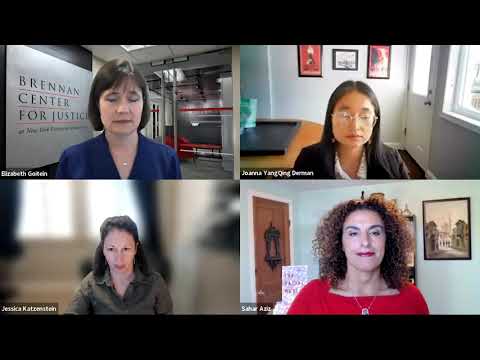
The United States has witnessed an explosive expansion of mass surveillance since the 9/11 attacks. The pervasive fear, Islamophobia, xenophobia, weakened civil liberties protections, and exponentially increased funding and surveillance capitalism of the post-9/11 era have enabled an unprecedented breadth and scale of surveillance reigning across the United States today—disproportionately impacting Muslims, immigrants, and protesters for racial, environmental, and labor justice.
In this one-hour webinar, Dr. Jessica Katzenstein, Postdoctoral Fellow in the Inequality in America Initiative at Harvard University, will present findings from a paper she authored for the Costs of War Project entitled, “Total Information Awareness: The High Costs of Post-9/11 U.S. Mass Surveillance,” and will be joined by Joanna YangQing Derman, Director of Anti-Profiling, Civil Rights and National Security at Asian Americans Advancing Justice and Elizabeth Goitein, Senior Director of the Liberty and National Security Program at the Brennan Center for Justice at NYU School of Law to discuss current mass surveillance policy issues. Moderating will be Dr. Sahar Aziz, Distinguished Professor of Law and Director of the Center for Security, Race and Right at Rutgers Law School.
,1,In January of 2019, journalist Elizabeth Rush joined 56 scientists and crew people aboard an ice-breaking research vessel to study the Thwaites glacier in Antarctica. The glacier, which is about the size of the state of Florida, has been nicknamed the “Doomsday Glacier” for the effect its disintegration would likely play in the rise of global sea levels.
“If we lose Thwaites, there's great concern that we will lose the entirety or big portions of the West Antarctic ice sheet and that those glaciers combined contain enough ice to raise global sea levels 10 feet or more,” Rush told Dan Richards on this episode of Trending Globally.
Rush recounts her voyage aboard the Palmer and how it reshaped her understanding of our changing climate and planet in her 2023 book, “The Quickening: Antarctica, Motherhood and Cultivating Hope in a Warming World.” However, as the title suggests, the book is also about another, more personal journey: Rush’s decision to have a child.
The resulting book is part adventure travelogue, part mediation on the meaning of motherhood, and part climate change manifesto. It also offers some much-needed wisdom on how to envision a future when it feels like the world is falling apart.
Learn more about and purchase “The Quickening” (https://milkweed.org/book/the-quickening)
Learn more about “The Conceivable Future” (https://www.conceivablefuture.org/)
Transcript coming soon to our website (https://trending-globally.captivate.fm/)
,1,Ambassador Victoria Nuland is Shelby Cullom Davis Professor in the Practice of International Diplomacy and Director of the International Fellows Program at the Columbia School of International and Public Affairs. A U.S. diplomat for 35 years, she served six U.S. Presidents and 10 Secretaries of State of both political parties and holds the rank of Career Ambassador. She was Acting Deputy Secretary of State from July 2023 until March 2024, and served concurrently as Under Secretary for Political Affairs. Her tenure as U/S for Political Affairs began in April 2021.
,1,Smuggling is typically thought of as furtive and hidden, taking place under the radar and beyond the reach of the state. But in many cases, governments tacitly permit illicit cross-border commerce, or even devise informal arrangements to regulate it. Drawing on extensive fieldwork in the borderlands of Tunisia and Morocco, Max Gallien explains why states have long tolerated illegal trade across their borders and develops new ways to understand the political economy of smuggling. His book, “Smugglers and States – Negotiating the Maghreb at its Margins” examines the rules and agreements that govern smuggling in North Africa, tracing the involvement of states in these practices and their consequences for borderland communities. It demonstrates that, contrary to common assumptions about the effects of informal economies, smuggling can promote both state and social stability. States not only turn a blind eye to smuggling, they rely on it to secure political acquiescence and maintain order, because it provides income for otherwise neglected border communities. More recently, however, the securitization of borders, wars, political change, and the pandemic have put these arrangements under pressure. Gallien explores the renegotiation of the role of smuggling, showing how stability turns into vulnerability and why some groups have been able to thrive while others have been pushed further to the margins.
ABOUT THE SPEAKER
Max Gallien is a political scientist specialising in the politics of informal and illegal economies, the political economy of taxation and the modern politics of the Middle East and North Africa. He is a research fellow at the Institute of Development Studies and a Research Lead and the International Centre for Tax and Development. He is the author of “Smugglers and States – Negotiating the Maghreb at its Margins” (Columbia University Press, 2024).
,1,Jeff Colgan, Director of Climate Solutions Lab (CSL) and Richard Holbrooke Professor of Political Science and International and Public Affairs, explains the Climate Syllabus Bank project at Climate Solutions Lab, located at the Watson Institute for International and Public Affairs at Brown University.
The Climate Solutions Lab syllabus bank fosters and improves university-level courses on climate change in the social sciences. At many universities, such courses are scarce — despite student demand on the world's most important global problem. For potential instructors, developing a new syllabus from scratch can be a barrier to teaching the course. So, we offer existing syllabi, for free, to anyone in the world. Different courses have different features, such as documentary films or class simulations.
We are extremely grateful to the instructors who have volunteered their syllabi for this purpose. More syllabi are welcome.
To submit a syllabus, please use this form: https://docs.google.com/forms/d/e/1FAIpQLSdTDGnl7u1_evbPhJ_MMSTqyUXEQMyJX6xrbGQo6C0ZemlIcQ/viewform
,1,On June 4, results came in from the largest democratic election in history. Over 640 million people voted in India’s election, which took place at over one million polling places across the country over the course of six weeks.
Many predicted that India’s prime minister Nerandra Modi and his party, the Bharatiya Janata Party (BJP) would dominate the election, grow their ranks in Parliament, and further impose their Hindu-nationalist ideology on the country.
However, that wasn’t what happened. Modi was reelected, but his party lost over 60 seats in the lower house of Parliament. The BJP will have to govern as part of a multi-party coalition, and most likely moderate their Hindu-nationalist aspirations.
On this episode, you’ll hear from Ashutosh Varshney, a political scientist at Brown University and director of the Watson Institute’s Saxena Center for Contemporary South Asia (https://watson.brown.edu/southasia/) , about this historic election: what led to its surprising outcome, what it means for the Hindu-nationalist movement embodied by Prime Minister Nerandra Modi, and what it might tell us about the struggle for democracy occurring in countries around the world.
*Trending Globally will be taking a brief summer hiatus, but we’ll be back in July with all-new episodes*
Learn more about the Saxena Center for Contemporary South Asia (https://watson.brown.edu/southasia/) at the Watson Institute
Learn more about the Watson Institute’s other podcasts (https://home.watson.brown.edu/news/podcasts)
Transcript coming soon to our website (https://trending-globally.captivate.fm/)
,1,Please join us as we welcome the following 6 writers to discuss their work.
Angie Cruz
Fred D'Aguiar
Francisco Goldman
Shara McCallum
Tiphanie Yanique
Javier Zamora
There will be a book signing and reception following the event.
Sawyer Seminar Series
,1,Join us for a book panel to discuss Black Grief/White Grievance: The Politics of Loss by Juliet Hooker, Professor of Political Science at Brown University. The other panelist include Cristina Beltran (NYU), Kevin Quashie (Brown University) and Thomas Zimmer (Georgetown).
In this book, Juliet Hooker, a leading thinker on democracy and race, argues that the two most important forces driving racial politics in the United States today are Black grief and white grievance. Black grief is exemplified by current protests against police violence—the latest in a tradition of violent death and subsequent public mourning spurring Black political mobilization. The potent politics of white grievance, meanwhile, which is also not new, imagines the U.S. as a white country under siege.
,1,Watson Institute and the Brown Center for Philosophy, Politics, and Economics is excited to welcome Professor John Aldrich for the John Hazen White, Sr., Lecture. Professor Aldrich specializes in American politics and behavior, formal theory, and methodology.
“Power, Policy, and Democratic Principles: Challenges Facing Congress” Dissatisfaction with government – including Congress perhaps above all – runs uncommonly high, and the practice of governing in the Congress is increasingly distasteful to nearly every observer. How has Congress changed so much over the last few decades? Are its practices really worse than in earlier eras? Does it matter that Members seem to dislike one another, that it is difficult for the Republican Party to select a leader, that narrow majorities appear to make governing even harder? Are there any silver linings?
JOHN H. ALDRICH. (Ph.D., Rochester), Pfizer-Pratt University Professor of Political Science, Duke University. He specializes in American and comparative politics and behavior, formal theory, and methodology. Books he has authored or co-authored include Why Parties, Why Parties Matter, Before the Convention, Interdisciplinary, Change and Continuity in the 2020 and 2022 Elections. He is past President of the Southern Political Science Association, the Midwest Political Science Association, and the American Political Science Association. He has been a Guggenheim Fellow and is a Fellow of the American Academy of Arts and Sciences. https://sites.duke.edu/aldrich/
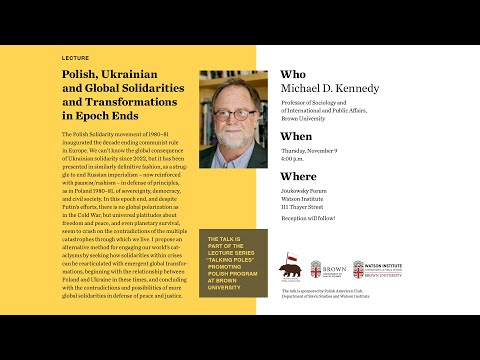
,1,Michael D. Kennedy, Professor of Sociology and of International and Public Affairs
The Polish Solidarity movement of 1980–81 inaugurated the decade ending communist rule in Europe. We can’t know the global consequence of Ukrainian solidarity since 2022, but it has been presented in similarly definitive fashion, as a struggle to end Russian imperialism – now reinforced with рашизм/rashism – in defense of principles, as in Poland 1980–81, of sovereignty, democracy, and civil society. In this epoch end, and despite Putin’s efforts, there is no global polarization as in the Cold War, but universal platitudes about freedom and peace, and even planetary survival, seem to crash on the contradictions of the multiple catastrophes through which we live. I propose an alternative method for engaging our world’s cataclysms by seeking how solidarities within crises can be rearticulated with emergent global transformations, beginning with the relationship between Poland and Ukraine in these times, and concluding with the contradictions and possibilities of more global solidarities in defense of peace and justice.
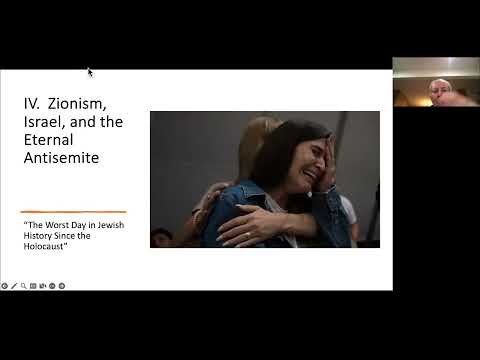
,1,Join the Watson Institute and Derek Penslar for an informal discussion on the current events in Israel-Gaza.
Derek Penslar, is the William Lee Frost Professor of Jewish History, Harvard University.
Moderated by, Omer Bartov, Samuel Pisar Professor of Holocaust and Genocide Studies
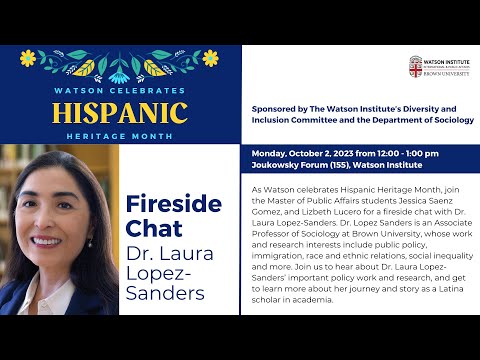
,1,As Watson celebrates Hispanic Heritage Month, join the Master of Public Affairs students Jessica Saenz Gomez, and Lizbeth Lucero for a fireside chat with Dr. Laura Lopez-Sanders. Dr. Lopez Sanders is an Associate Professor of Sociology at Brown University, whose work and research interests include public policy, immigration, race and ethnic relations, social inequality and more. Join us to hear about Dr. Laura Lopez-Sanders’ important policy work and research, and get to learn more about her journey and story as a Latina scholar in academia.
,1,The Watson Institute hosts a panel of Brown faculty for an analysis of the complexities of the ongoing war on Ukraine. Panelists will be exploring a wide range of critical topics ranging from biosecurity threats to deescalation. Moderated by Edward Steinfeld, director, Watson Institute for International and Public Affairs.
Panelists:
Volha Biziukova, Postdoctoral Fellow in International and Public Affairs
Lyle Goldstein, Visiting Professor of International and Public Affairs
Wilmot James, Senior Advisor to the Brown Pandemic Center, Professor of the Practice of Health Services, Policy and Practice at the Brown University School of Public Health
Rose McDermott, David and Marianna Fisher University Professor of International Relations
,1,Andrea Gutierrez, Sarah Khan, Sylvia Houghteling and Yael Rice — Crafting Cuisine: A Celebration of Food and Art in South Asia
Friday, December 1, 2023
2:00 PM to 4:00 PM EST
McKinney, 111 Thayer Street
Join us for Crafting Cuisine: A Celebration of Food and Art in South Asia with subject matter experts Andrea Gutierrez, Sarah Khan, Sylvia Houghteling and Yael Rice.
Andrea Gutierrez is an Assistant Professor of Instruction at The University of Texas at Austin. In her work, she researches Pre-modern South Asia, South Asian Food History, and Animal Studies in South Asia. She has delved into the historical intersections of food and spirituality in early India, and has not only explored diverse topics such as animal language in ancient texts and temple rituals but has also been recognized for their exceptional research through prestigious awards such as the ICAS Book Prize and the Getty Library Research Grant
Sarah Khan is the EPE Director of Undergraduate Studies/Assistant Professor at Yale University. She researches gender and comparative politics, with a regional specialization in South Asia. In her work, she studies gender gaps in political preferences, and the barriers to women’s political participation and representation. She also researches strategies to prevent and address violence against women in the developing world.
Sylvia Houghteling is an Associate Professor of History of Art at Bryn Mawr. She specializes in early modern visual and material culture with a focus on the history of textiles, South Asian art and architecture, and the material legacies and ruptures of European colonialism. Houghteling’s first book, The Art of Cloth in Mughal India (Princeton University Press, 2022), a recipient of a College Art Association Millard Meiss Publication Fund Grant, examined the textiles crafted and collected across the Mughal Empire in the sixteenth and seventeenth centuries, showing how woven objects helped to shape the social, political, religious, and aesthetic life of early modern South Asia. Her ongoing research is concerned with questions of temporality and the unique material histories of the Indian Ocean trade.
Yael Rice is the Chair of Architectural Studies/Associate Professor of Art & the History of Art and of Asian Languages and Civilizations at Amherst College. She specializes in the art and architecture of South Asia and Greater Iran, with a particular focus on manuscripts and other portable arts of the fifteenth through eighteenth centuries. Between 2009-12, she held the position of Assistant Curator of Indian and Himalayan Art at the Philadelphia Museum of Art, and in that capacity curated exhibitions of court portraits from South Asia, ragamala paintings, and works by Rabindranath Tagore and other seminal Bengali artists of the early twentieth century.
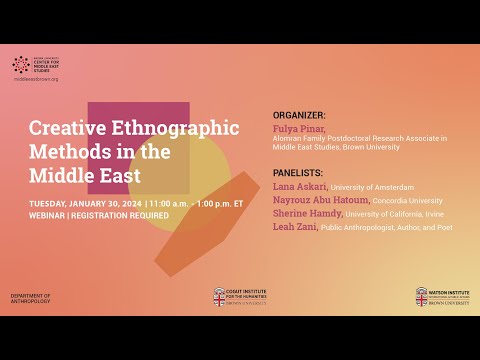
,1,About the Event
Hosting four panelists working with different communities of the Middle East, this webinar will unravel diverse uses of creative and experimental methods in anthropology beyond the conventional modes of academic writing – such as poetry, graphic novel and documentary. Through examples from the panelists’ works, the webinar will explicate how using such methods facilitate and complicate ethnographic knowledge production. It will also provide insights to people interested in utilizing creative methods in their analytical thinking.
About the Organizer
Alomran Postdoctoral Research Associate Fulya Pinar
About the Panelists
Nayrouz Abu Hatoum (Concordia University)
Lana Askari (University of Amsterdam)
Sherine Hamdy (University of California, Irvine)
Leah Zani (public anthropologist, author, and poet).
Cosponsored by the Department of Anthropology and the Cogut Institute for the Humanities
,1,Rohini Somonathan is Professor of Economics at the Delhi School of Economics. She received her Ph.D in 1996 from Boston University and held faculty positions at Emory University, the University of Michigan and the Indian Statistical Institute before joining the Delhi School of Economics in 2005. Her research focuses on how social institutions interact with public policies to shape patterns of economic and social inequality. She is particularly interested in exploring the intellectual and ideological environment within which state policy is created and justified. Within the broad area of development economics, she has worked on group identity and public goods, gender equality, child nutrition and environmental quality.
,1,This is part three in our companion series to the book “Diminishing Returns: The New Politics of Growth and Stagnation” (co-edited by Mark Blyth, Lucio Baccaro and Jonas Pontusson).
On this episode, Mark talks with four contributors for the book: Alex Reisenbichler, Aidan Regan, Oddný Helgadóttir, and Jonas Nahm. They look at case studies in a handful of countries, as well as some of the cross-cutting trends affecting all growth models across the world. They explore the role of finance and politics in growth models, and how the climate crisis is making us rethink this all even further.
,1,Out of a pre-war Syrian population of 24 million, at some point during the ongoing conflict, there were about 250,000 Syrians detained in its many prisons, a percentage of the population (1%) that dwarfs that of many other authoritarian regimes. Imprisonment may well be a defining characteristic of postcolonial Syrian history, and its widespread violence under especially the Assad regime since 1970 has made a profound impact on Syrian society. Yet due to the strict secrecy, censorship, and pervasive fear surrounding prisons, as well as the ‘conspiracy of silence’ between perpetrators and victims, Syrian prisons have not been examined systematically. The initiative for Syrian Gulag emerged out of a 2017 meeting between novelist, documentary filmmaker, human rights activist, researcher, and former detainee Jaber Baker, and Üngör. The book offers an examination of Syria’s prison system, using a combination of sources and methods, including published sources such as memoirs, social media data, leaked regime files, and oral history interviews. It looks into the structure and functioning of arrest, detention, and torture, discusses the identities of the perpetrators, and probes the experiences of the survivors, including how they overall fared after fleeing abroad.
About the speaker
Uğur Ümit Üngör is Professor of Holocaust and Genocide Studies at the University of Amsterdam and the NIOD Institute for War, Holocaust, and Genocide Studies. His main area of interest is the history and sociology of mass violence, with a particular focus on the modern and contemporary Middle East. He has won several academic awards and held visiting positions in Dublin, Vancouver, Budapest, Toronto, Los Angeles, and Edinburgh. He has published books and articles on various aspects and cases of mass violence and genocide, including The Making of Modern Turkey: Nation and State in Eastern Anatolia, 1913-1950 (Oxford University Press, 2011), Paramilitarism: Mass Violence in the Shadow of the State (Oxford University Press, 2020), and the forthcoming Assad’s Militias and Mass Violence in Syria (Cambridge University Press, 2024).
,1,Please join us Monday, October 2nd from 3:00pm-5:00pm In the McKinney Conference Room, 3rd Floor, located at 111 Thayer Street to support our NIH- funded Brown/UCT training partnership and program: BRIDGES- geared to increase the diversity and quality of doctoral training in public heath in South Africa.
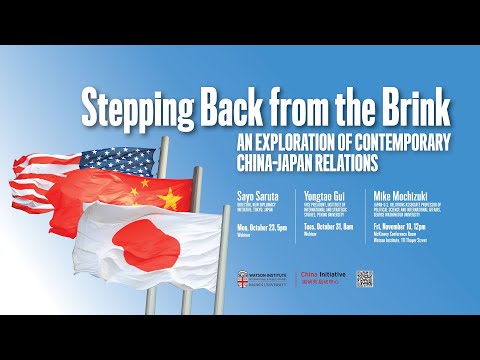
,1,Join Lyle Goldstein, Visiting Professor of International and Public Affairs, for a conversation with Mike Mochizuki, Japan-U.S. Relations Associate Professor of Political Science and International Affairs at George Washington University. This is the final event in a series of talks about the China-Japan relationship, “Stepping Back from the Brink: An Exploration of Contemporary China-Japan Relations.”
Professor Mochizuki holds the Japan-U.S. Relations Chair in Memory of Gaston Sigur at the Elliott School of International Affairs at The George Washington University. Dr. Mochizuki was director of the Sigur Center for Asian Studies from 2001 to 2005. He co-directs the “Memory and Reconciliation in the Asia-Pacific” research and policy project of the Sigur Center. Previously, he was a Senior Fellow at the Brookings Institution. He was also Co-Director of the Center for Asia-Pacific Policy at RAND and has taught at the University of Southern California and Yale University.
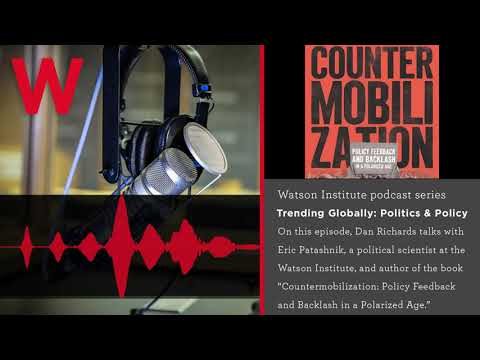
,1,Backlash is hardly a new political force — since America’s founding, change has often been driven by citizens mobilizing in opposition to policies, programs, or social movements.
But recently, as our guest on this episode explains, backlash movements have come to dominate our politics in unprecedented ways. He argues that to build a more stable and healthy politics, we need to better understand how these forces work.
Why do certain policies, movements, or individual politicians incite powerful backlash movements while others don't? And why — whether we’re talking about immigration, healthcare, reproductive rights, or countless other issues — has backlash come to dominate so many different policy realms?
On this episode, Dan Richards explores these questions with Eric Patashnik, a political scientist at the Watson Institute, and author of the book “Countermobilization: Policy Feedback and Backlash in a Polarized Age.” In the book, Patashnik provides a theory of political backlash — what causes it, why it’s diffused through our politics over the last few decades, and how policymakers and politicians can learn to remain effective in a political moment dominated by backlash and countermobilization.
,1,Mark Blyth, political economist at Brown University's Watson Institute for International and Public Affairs, and Carrie Nordlund, political scientist and Assistant Dean for Undergraduate Programs at Brown University, share their take on the news.
On this episode:
Trump’s domination of the GOP primary after winning Iowa and New Hampshire, and what the MAGA-ficaiton of the GOP means for 2024
The E. Jean Carroll decision against Trump and what does this and the rest of the court cases mean for Trump’s candidacy
Making sense of America’s “vibe-cession” and disinflation
Claudine Gay’s resignation as Harvard’s president, and the Right’s strange relationship to the Ivy League
Where does China’s economy go next?
Unpacking the calls to ban Germany’s right-wing Alternative for Germany (AfD) party.
Why is the UK trying to send asylum-seekers to Rwanda?
The Super Bowl meets the Taylor Swift-industrial complex
,1,The United States has witnessed an explosive expansion of mass surveillance since the 9/11 attacks. The pervasive fear, Islamophobia, xenophobia, weakened civil liberties protections, and exponentially increased funding and surveillance capitalism of the post-9/11 era have enabled an unprecedented breadth and scale of surveillance reigning across the United States today—disproportionately impacting Muslims, immigrants, and protesters for racial, environmental, and labor justice.
In this one-hour webinar, Dr. Jessica Katzenstein, Postdoctoral Fellow in the Inequality in America Initiative at Harvard University, will present findings from a paper she authored for the Costs of War Project entitled, “Total Information Awareness: The High Costs of Post-9/11 U.S. Mass Surveillance,” and will be joined by Joanna YangQing Derman, Director of Anti-Profiling, Civil Rights and National Security at Asian Americans Advancing Justice and Elizabeth Goitein, Senior Director of the Liberty and National Security Program at the Brennan Center for Justice at NYU School of Law to discuss current mass surveillance policy issues. Moderating will be Dr. Sahar Aziz, Distinguished Professor of Law and Director of the Center for Security, Race and Right at Rutgers Law School.
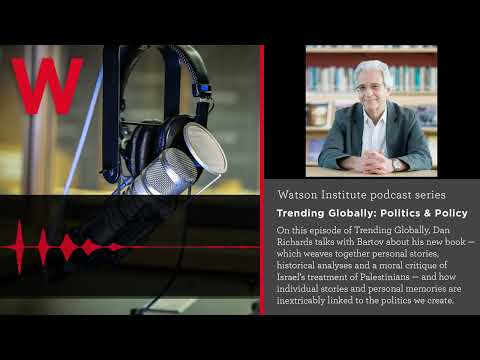
,1,How do our individual experiences shape our political views? What role do our own stories and memories play in how we think about the world around us? How can we use our memories — even our most painful ones — to help build a more peaceful politics?
These are complicated questions, and not of the variety we often ask on this show. But historian Omer Bartov thinks that trying to answer them is essential to finding political solutions to our most vexing problems. And in his new book “Genocide, the Holocaust and Israel-Palestine: First-Person History in Times of Crisis,” Bartov powerfully makes the case.
On this episode of Trending Globally, Dan Richards talks with Bartov about the book — which weaves together personal stories, historical analyses and a moral critique of Israel’s treatment of Palestinians — and how individual stories and personal memories are inextricably linked to the politics we create.
Although this podcast was scheduled before the current Israeli-Palestinian crisis, the interview took place in the wake of the events of October 7 and therefore those events are a big part of the conversation. But as this conversation hopefully makes clear, Bartov’s book and analysis are even more important and relevant in our current moment.
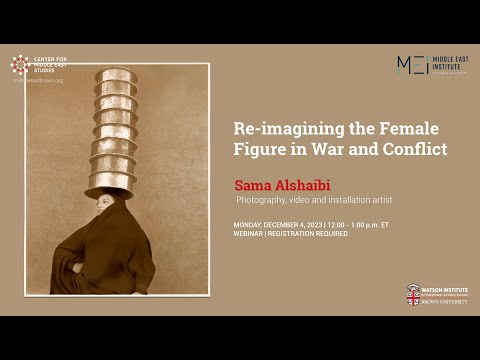
,1,About the Event
In conversation with conceptual artist Sama Alshaibi, Brown University professor Nadje Al-Ali and Columbia University professor Kathryn Spellman Poots will discuss her art and the significance of war, exile, borders and environmental destruction in her work. What role do gender and her body play in her work? And how does her art draw on historical sources and contemporary realities to express exploitations of freedom?
This conversation is part of a joint Center for Middle East Studies at Brown University and the Middle East Institute at Columbia University series on gender, art and body politics in the Middle East and its diasporas. The series examines intersecting inequalities and body politics expressed, represented and transgressed in both visual and performance art.
About the Speaker
Born in Iraq and now based in the United States, Sama Alshaibi is an artist working between photography, video and installation. Her practice explores the notion of aftermath—the fragmentation and dispossession that violates the individual and a community following the destruction of their social, natural and built environment. She often complicates the coding of the Arab female figure found in the image history of photographs and moving images.
In 2021, Alshaibi was named a Guggenheim Fellow and the recipient of the Phoenix Art Museum’s Arlene and Morton Scult Artist Award. Her work has been exhibited in numerous biennales and museums, including the 55th Venice Biennale, the 2020 State of the Art (Crystal Bridges Museum of Art), Museum of Modern Art (NYC), Institut Du Monde Arabe (Paris) and Barjeel Foundation (U.A.E.), among others. In 2015, Aperture published her monograph Sama Alshaibi: Sand Rushes In, featuring the artist’s Silsila series. Alshaibi is a Regents Professor of Art at the University of Arizona, USA.
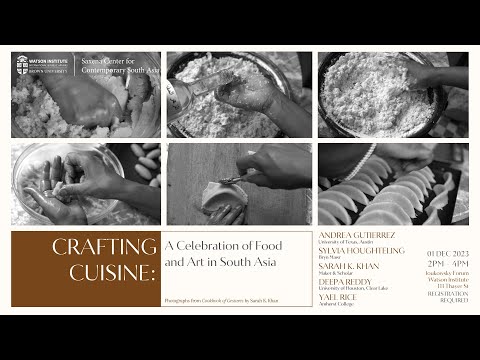
,1,Join us for Crafting Cuisine: A Celebration of Food and Art in South Asia with subject matter experts Andrea Gutierrez, Sarah K. Khan, Deepa S. Reddy, Sylvia Houghteling and Yael Rice.
“Nala as a Mirror to Buttermilks: Accessing Place and Time” with Deepa Reddy and Andrea Gutierrez
“Ephemeral Tie-and-Dye” with Sylvia Houghteling
Engage with your sense of smell while creating a foldable book that highlights the ovens depicted in an illustrated recipe book from early sixteenth-century central India. Art historian Yael Rice and artist Sarah Khan will guide you through the process and reveal invisible histories and narratives untold that include the migration of people, plants and ideas.
Andrea Gutierrez teaches at the University of Texas at Austin in the Department of Asian Studies. Andrea uses Sanskrit, Prakrits, and Tamil languages to conduct research on projects concerning food history of South Asia and animal studies for the region. Andrea has recently published on medieval temple food in the Journal of Hindu Studies (“Toward a Better Understanding of Medieval Food Practices: The View from Srirangam” https://doi.org/10.1093/jhs/hiad016) and on medieval captive elephant training (“Elephant Education, Linguistic Articulation, or Punishment? Gajasiksha as Interspecies Communication in Elephant Manuals of Early India” https://www.bloomsbury.com/us/conversations-with-the-animate-other-9789356403055/). Gutiérrez is presently preparing a book manuscript tentatively called Royal Pleasures: Recipes & Dining in India’s History.
Sylvia Houghteling is an Associate Professor of History of Art at Bryn Mawr. She specializes in early modern visual and material culture with a focus on the history of textiles, South Asian art and architecture, and the material legacies and ruptures of European colonialism. Houghteling’s first book, The Art of Cloth in Mughal India (Princeton University Press, 2022), a recipient of a College Art Association Millard Meiss Publication Fund Grant, examined the textiles crafted and collected across the Mughal Empire in the sixteenth and seventeenth centuries, showing how woven objects helped to shape the social, political, religious, and aesthetic life of early modern South Asia. Her ongoing research is concerned with questions of temporality and the unique material histories of the Indian Ocean trade.
Sarah K Khan (b. Mangla, Pakistan) utilizes food to provoke thought about injustice towards people and the planet. She explores food, culture, women, migration, and identity in urban and rural environments. A maker and scholar, she uses photography, films, print-making, maps, ceramics and writing. A two-time Fulbright recipient, Khan earned a BA in Middle Eastern history and Arabic (Smith College), two Masters (public health and nutrition, Columbia University) and a Ph.D. (traditional ecological knowledge systems, plant sciences, New York Botanical Garden-CUNY). She has received numerous grants, fellowships, and residencies to pursue her work. Most recent residencies include Anderson Ranch Residency (2024), Women Studio Workshop (2023), Kohler Arts/Industry Residency (2022), Princeton Artist-in-Residence ArtHx (2021-22), Ellis Beauregard (2021), Monson Arts (2021), Project for Empty Space Feminist Residency (2020), Indigo Arts Alliance (2019), and as the Boren Chertkov Residency for Labor and Justice at Blue Mountain Center (2019).
Deepa S Reddy is a cultural anthropologist with the University of Houston-Clear Lake: tenured faculty and then part-time working from India since 2000. Her book, Religious Identity and Political Destiny, was published with Rowman and Littlefield in 2006; she was part of an editorial collective that curated a volume on public expressions of hinduness, Public Hinduisms (Sage, 2010), which is currently being revised for re-publication. From 2004-8 she was co-investigator on an NIH-funded project to understand “Indian and Hindu perspectives on Genetic Variation Research”; between 2017-18, she was lead researcher (Chennai) for “The Asthma Files”: a global, multi-city study of air quality and environmental governance in cities around the world, including six in India. She has also published on the Indian women’s movement, caste politics, and religious nationalism, as well as on Indian and Hindu perspectives on human genetic variation, bio-politics, and constructions of the civic.
Yael Rice is associate professor of art history and of Asian languages and civilizations at Amherst College. She specializes in the art and architecture of South Asia, Central Asia, and Iran, with a particular focus on manuscripts and other portable arts of the fifteenth through eighteenth centuries. She is the author of the recently published The Brush of Insight: Artists and Agency at the Mughal Court (University of Washington Press, 2023).
,1,Religion of Famous People | Famous Celebrities and Their Religion #rrdatacomparison
If you enjoyed this video then Please
Like, Share & Subscribe!!!
Part-1 ?? https://youtu.be/YhFRQOjFrrk
Your Queries ??
Famous persons religion
Famous personalities religions
Famous personalities religion
Famous peoples religion from different countries
Famous celebrities and their religion
Famous celebrities religion
Popular celebrities religion
Vladimir putin religion
Hugh jackman
Steve jobs religion
Veba
hug elon musk
Elon musk religion
Data comparison video
World data comparison 1m
Global data comparison
All world data comperison
Comparison world data
Bruce lee religion
Ratan tata religion
cristiano ronaldo religion
#datacomparison #celebrities #religions #viral
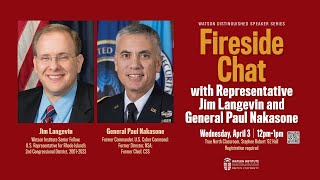
,Watson Institute,Watson International Institute,Brown University,Brown u,Brown,Public Affairs,NSA,Foreign Intelligence,Cyber Security,OxAG3SKPdKo,, Military,Politics,Society, channel_UCok8bs3XNbyU93LMwQ4A55w, video_OxAG3SKPdKo,Join Watson Senior Fellow Jim Langevin, former Congressman for Rhode Island’s 2nd District, for a fireside chat with General Paul Nakasone, the recently retired Commander of the U.S. Cyber Command, Director of the National Security Agency and Chief of the Central Security Service.
GEN Paul M. Nakasone retired on February 1, 2024 after serving as Commander, U.S. Cyber Command, Director, NSA/Chief, CSS since May of 2018.
He previously commanded U.S. Army Cyber Command from October 2016 - April 2018.
A native of White Bear Lake, Minnesota, GEN Nakasone is a graduate of Saint John’s University in Collegeville, Minnesota, where he received his commission through the Reserve Officers’ Training Corps.
GEN Nakasone has held command and staff positions across all levels of the Army with assignments in the United States, the Republic of Korea, Iraq, and Afghanistan.
GEN Nakasone commanded the Cyber National Mission Force at U.S. Cyber Command. He has also commanded a company, battalion, and brigade, and served as the senior intelligence officer at the battalion, division and corps levels.
GEN Nakasone has served in Joint and Army assignments in the United States, the Republic of Korea, Iraq, and Afghanistan. His most recent overseas posting was as the Director of Intelligence, J2, International Security Assistance Force Joint Command in Kabul, Afghanistan.
GEN Nakasone has also served on two occasions as a staff officer on the Joint Chiefs of Staff.
GEN Nakasone is a graduate of the U.S. Army War College, the Command and General Staff College, and Defense Intelligence College. He holds graduate degrees from the U.S. Army War College, the National Defense Intelligence College, and the University of Southern California.
GEN Nakasone’s awards and decorations include the Distinguished Service Medal (with oak leaf cluster), the Defense Superior Service Medal (with three oak leaf clusters), Legion of Merit, Bronze Star, Defense Meritorious Service Medal (with oak leaf cluster), Army Commendation Medal, Joint Service Achievement Medal (with oak leaf cluster), Army Achievement Medal (with four oak leaf clusters), Joint Meritorious Unit Award, Iraq Campaign Medal, Afghanistan Campaign Medal, Combat Action Badge, and the Joint Chiefs of Staff Identification Badge.
,1,About the Event
This event takes up queer subjectivity and resistances in the Caribbean, with a focus on LGBTQ+ women, through the launch and discussion of new and forthcoming books by Dr. Nikoli Attai, Defiant Bodies: Making Queer Community in the Anglophone Caribbean, and Dr. Preity Kumar, An Ordinary Landscape of Violence: Women Loving Women in Guyana (tentative title). Central are questions about the conceptualization of queerness outside of a global north or western framework, how violence is resisted, and how we can embrace gendered and sexual diversity in our imaginings of the Caribbean.
About the Speakers
Moderator: Kamala Kempadoo
Panelists:
Nikoli Attai, Colorado State University
Preity Kumar, University of Rhode Island
Cosponsored by the LGBTQ Center
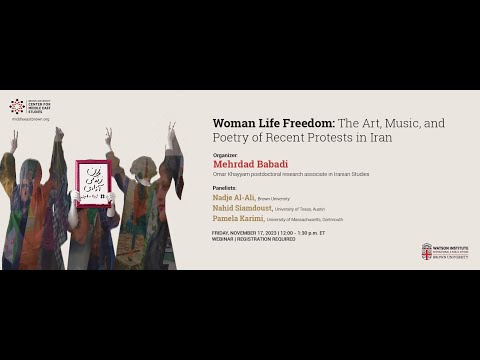
,1,Apart from its feminist edge and the extraordinary bravery of the youth, one prominent feature of Iran’s 2022-23 Woman Life Freedom uprising has been the prolific production and creative use of arts, music, and poetry as major means of political activism and protest. Since the tragic murder of the 22-year-old Mahsa Zhina Amini by the “morality police,” protesters have put together words, images, music, and movement to express their frustrations against the injustices of the state and to demand their rights to life, youthfulness, and freedom. Slogans, poetry, songs, video clips, paintings, graffiti, and dances are produced and performed by young artists and ordinary participants alike. In this online event, we will be in conversation with two distinguished experts in Iranian politics, culture, and arts to discuss how women have reclaimed their voices for life and freedom and to analyze the emerging characteristics of Iranian art of protest since the start of the uprisings.
Panelists:
Nadje Al-Ali, Brown University
Nahid Siamdoust, University of Texas, Austin
Pamela Karimi, University of Massachusetts, Dartmouth
,1,Join Professor Wendy J. Schiller for a discussion around domestic violence and gun safety reform in the United States. Professor Schiller will offer a short lecture on her research, followed by a Q&A moderated by Daniel Poloner ’24, Chair of the Watson Student Advisory Council, and a research assistant on Professor Schiller’s project on this critical policy issue.
Wendy J. Schiller is Professor of Political Science, Professor of International and Public Affairs and Director of the Taubman Center for American Politics and Policy at the Watson Institute. She teaches popular courses including, The American Presidency, Introduction to the American Political Process, and Congress and Public Policy. Among her many publications, Professor Schiller recently co-authored a new book titled, Inequality Across State Lines: How Policymakers Have Failed Domestic Violence Victims in the United States.
Cosponsored by the Watson Student Advisory Council and IAPA DUG.
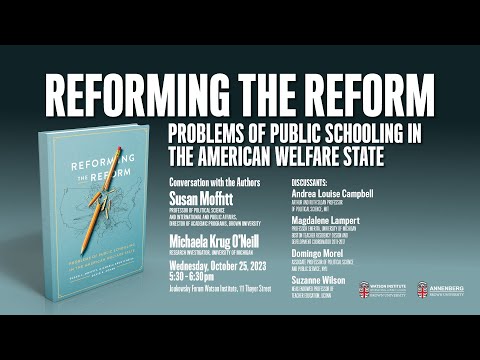
,1,An expansive study of the problems encountered by educational leaders in pursuit of reform, and how these issues cyclically translate into future topics of reform.
School reform is almost always born out of big dreams and well-meaning desires to change the status quo. But between lofty reform legislation and the students whose education is at stake, there are numerous additional policies and policymakers who determine how reforms operate. Even in the best cases, school reform initiatives can perpetuate problems created by earlier reforms or existing injustices, all while introducing new complications. In Reforming the Reform, political scientist Susan L. Moffitt, education policy scholar Michaela Krug O’Neill, and the late policy and education scholar David K. Cohen take on a wide-ranging examination of the many intricacies of school reform.
With a particular focus on policymakers in the spaces between legislation and implementation, such as the countless school superintendents and district leaders tasked with developing new policies in the unique context of their district or schools, the authors identify common problems that arise when trying to operationalize ambitious reform ideas. Their research draws on more than 250 interviews with administrators in Tennessee and California (chosen as contrasts for their different political makeup and centralization of the education system) and is presented here alongside survey data from across the United States as well as archival data to demonstrate how public schools shoulder enormous responsibilities for the American social safety net. They provide a general explanation for problems facing social policy reforms in federalist systems (including healthcare) and offer pathways forward for education policy in particular.
Conversation with the Authors
Susan Moffitt, Professor of Political Science and International and Public Affairs, Director of Academic Programs, Brown University
Michaela Krug O’Neill, Research Investigator, University of Michigan
Discussants:
Andrea Louise Campbell, Arthur and Ruth Sloan Professor of Political Science, MIT
Magdalene Lampert, Professor Emerita, University of Michigan, Boston Teacher Residency Design and Development Coordinator 2011 - 2017
Domingo Morel, Associate Professor of Political Science and Public Service, NYU
Suzanne Wilson, Neag Endowed Professor of Teacher Education, UCONN
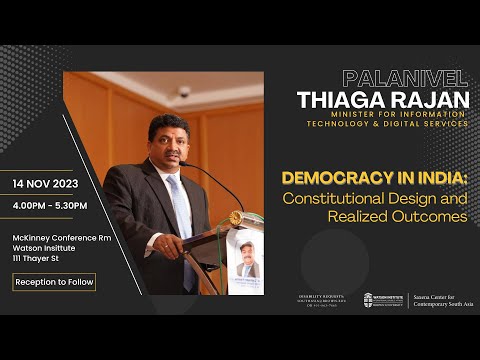
,1,Borrowing heavily from the unwritten Constitution of the United Kingdom, and after 2-years of debates in the Constituent Assembly, India adopted its Constitution, the basis for its Republic. Join us for a talk with Dr. Palanivel Thiaga Rajan, former Finance Minister of Tamil Nadu, that will touch upon core constructs such as administration and governance, representation of citizens, and the separation and execution of powers to consider whether the outcomes over the last roughly 75 years have delivered on the vision of the Constituent Assembly.
Dr. Palanivel Thiaga Rajan serves as the Minister for Information Technology & Digital Services, Earlier he served as the Minister for Finance & Human Resources Management in the Government of Tamil Nadu, India. During his stint as Finance Minister, Hon’ble Chief Minister of Tamil Nadu Thiru M.K.Stalin nominated Dr Palanivel Thiaga Rajan to the Goods & Service Tax Council (GST Council) as a GST Council Member to represent the Government of Tamil Nadu. Dr Palanivel Thiaga Rajan was also a member of the Group ofMinisters (GoM) on (1) System Reforms (standing committee) & (2) Casinos, Race Courses and Online Gaming as nominated by the Chairperson of the GST Council i.e., Hon’ble Union Minister for Finance,Government of India.
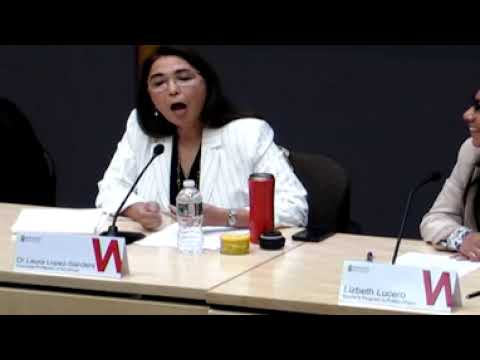
,1,As Watson celebrates Hispanic Heritage Month, join the Master of Public Affairs students Jessica Saenz Gomez, and Lizbeth Lucero for a fireside chat with Dr. Laura Lopez-Sanders. Dr. Lopez Sanders is an Associate Professor of Sociology at Brown University, whose work and research interests include public policy, immigration, race and ethnic relations, social inequality and more. Join us to hear about Dr. Laura Lopez-Sanders’ important policy work and research, and get to learn more about her journey and story as a Latina scholar in academia.
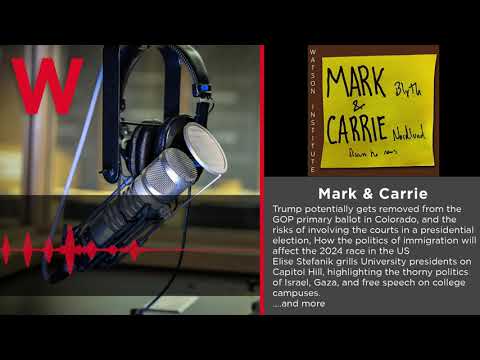
,1,Mark Blyth, political economist at Brown University's Watson Institute for International and Public Affairs, and Carrie Nordlund, political scientist and Assistant Dean for Undergraduate Programs at Brown University, share their take on the news.
On this episode:
Trump potentially gets removed from the GOP primary ballot in Colorado, and the risks of involving the courts in a presidential election
How the politics of immigration will affect the 2024 race in the US
Elise Stefanik grills University presidents on Capitol Hill, highlighting the thorny politics of Israel, Gaza, and free speech on college campuses
The political economy of Argentina’s new president Javier Milei
The Fed decides to hold interest rates steady, and the market reacts with…enthusiasm
China’s economic slowdown, and the limits of growth in authoritarian societies
Where the Israeli-Gaza conflict goes from here, and how it might affect US politics going forward
Google’s loss in court to Epic Games, and American’s very mixed record regulating monopolies.
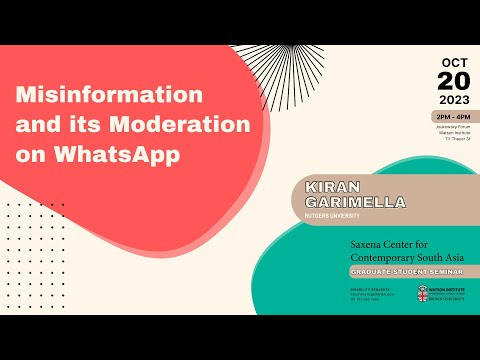
,1,Join us for a Graduate Student Seminar - Misinformation and its Moderation on WhatsApp with subject matter expert Kiran Garimella.
Kiran Garimella is an Assistant Professor in the School of Communication and Information at Rutgers University. Kiran’s research is focused on building innovative, opt-in, privacy preserving data-collection tools for platforms like WhatsApp, with the goal of developing interventions to stop/slow the spread of misinformation.
,1,Chandra Bhan Prasad is an Indian scholar, political commentator, and author of the Bhopal Document, impacted the policies of the Indian state of Madhya Pradesh and has been widely cited in discourses on Dalits. Prasad is the co-author author of Defying the Odds: The Rise of Dalit Entrepreneurs (with D Shyam Babu and Devesh Kapur), Dalit Phobia: Why Do They Hate Us?, What is Ambedkarism?, and Dalit Diary, 1999-2003: Reflections on Apartheid in India. He is also the founder of the ByDalits.com platform and the editor of Dalit Enterprise Magazine and has been widely quoted by the world press on issues of caste and the treatment of Dalits in India. Prasad’s main areas of research and writing are Dalit capitalism, India’s march to modernity, and Westernization in India.