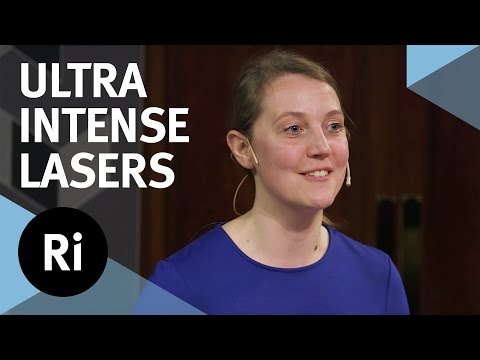
The most powerful lasers in the world can be used to make some of the most extreme conditions possible on earth, and are revolutionising science. Dr Kate Lancaster leads you through this extreme world with demonstrations along the way. http://bit.ly/RiSubscRibe
When lasers were invented over half a century ago they were hailed as a “solution looking for a problem”. Since then lasers have come to revolutionise our lives through their practical applications such as data transport and CD/ DVD players, and as a tool for industry and science.
The largest and most powerful lasers in the world can be used to make some of the most extreme conditions possible on earth. Scientists around the globe are using these lasers to try to miniaturise particle accelerators, make astrophysical conditions in the lab, and create fusion energy. Dr Kate Lancaster leads you through this extreme world with demonstrations along the way in celebration of the International Year of Light.
Kate Lancaster was awarded a PhD in Advanced Fast Ignition studies (laser driven fusion) by Imperial College London before working at the Central Laser Facility at the Rutherford Appleton Laboratory.
Her background is in laser plasma interactions and laser driven fusion and she is now the Plasma and Fusion industrial officer for the York Plasma Institute, University of York.
Subscribe for regular science videos: http://bit.ly/RiSubscRibe
The Ri is on Twitter: http://twitter.com/ri_science
and Facebook: http://www.facebook.com/royalinstitution
and Tumblr: http://ri-science.tumblr.com/
Our editorial policy: http://www.rigb.org/home/editorial-policy
Subscribe for the latest science videos: http://bit.ly/RiNewsletter
,1,2025 is the International Year of Quantum Science and Technology, as marked by the UN, to celebrate 100 years since the birth of quantum mechanics. But quantum science is one of the least diverse areas of science in terms of gender and other protected characteristics.
Jess Wade, a physicist and lecturer in functional materials at Imperial College London, has been fighting the inequality in quantum physics and beyond by creating thousands of Wikipedia pages for women scientists. Jess joins us this month to discuss the past, present, and future of quantum science along with what can be done to increase diversity within the field.
Ri Science Podcast episodes are released on the last Wednesday of every month. Subscribe wherever you get your podcasts to be notified as soon as episodes are released!
---
Jess Wade is a British physicist in the Blackett Laboratory at Imperial College London, specialising in Raman spectroscopy. Her research investigates polymer-based organic light emitting diodes (OLEDs). Her public engagement work in science, technology, engineering, and mathematics (STEM) advocates for women in physics as well as tackling systemic biases such as gender and racial bias on Wikipedia. Read more about here here: https://en.wikipedia.org/wiki/Jess_Wade
---
Producer: Lia Hale
Assistant producers: Katie Mortimer, Isla Nakano
Interviewer: Lia Hale
Music: Joseph Sandy
--
Join this channel to get access to perks:
https://www.youtube.com/channel/UCYeF244yNGuFefuFKqxIAXw/join
Subscribe for regular science videos: http://bit.ly/RiSubscRibe
The Ri is on Twitter: http://twitter.com/ri_science
and Facebook: http://www.facebook.com/royalinstitution
and TikTok: https://www.tiktok.com/@ri_science
Listen to the Ri podcast: https://podcasters.spotify.com/pod/show/ri-science-podcast
Donate to the RI and help us bring you more lectures: https://www.rigb.org/support-us/donate-ri
Our editorial policy: https://www.rigb.org/editing-ri-talks-and-moderating-comments
Subscribe for the latest science videos: http://bit.ly/RiNewsletter
Product links on this page may be affiliate links which means it won't cost you any extra but we may earn a small commission if you decide to purchase through the link.
,1,Join this channel to get access to perks:
https://www.youtube.com/channel/UCYeF244yNGuFefuFKqxIAXw/join
Subscribe for regular science videos: http://bit.ly/RiSubscRibe
The Ri is on Twitter: http://twitter.com/ri_science
and Facebook: http://www.facebook.com/royalinstitution
and TikTok: https://www.tiktok.com/@ri_science
Listen to the Ri podcast: https://podcasters.spotify.com/pod/show/ri-science-podcast
Donate to the RI and help us bring you more lectures: https://www.rigb.org/support-us/donate-ri
Our editorial policy: https://www.rigb.org/editing-ri-talks-and-moderating-comments
Subscribe for the latest science videos: http://bit.ly/RiNewsletter
Product links on this page may be affiliate links which means it won't cost you any extra but we may earn a small commission if you decide to purchase through the link.
,1,In the first of his CHRISTMAS LECTURES, Richard Dawkins explores the origins of life. Beginning with a look at our ancestry, he shows how the probability of our existence is very small.
Watch all the lectures in this series here: https://www.youtube.com/playlist?list=PLbnrZHfNEDZwJw3_jDeusmHuVYDdKRpo9
Watch our newest Christmas lectures here: https://www.youtube.com/playlist?list=PLbnrZHfNEDZyQJZLPMjwEoOLdkFBLU2m1
This lecture was filmed at the Ri on 1 December 1991.
These lectures were originally a YouTube member exclusive for our Science Supporters, and now we’re putting them out for everyone to watch. If you can’t wait for them all to be published, get access now by signing up as a YouTube channel member, and help us bring science to more people: https://www.youtube.com/channel/UCYeF244yNGuFefuFKqxIAXw/join
---
Life grows up in the universe by gradual degrees of evolution. Billions of years ago, there existed a vast population of bacteria. But it was only an elite group of these bacteria that evolved to become humans. In truth, we are lucky to be alive.
In the first of his CHRISTMAS LECTURES, Richard Dawkins explores the origins of life. Beginning with a look at our ancestry, he shows how the probability of our existence is very small. Becoming an ancestor is much more difficult than simple reproduction, and Richard reveals how our ancestors did what it took to survive and pass on their genes.
But although some of our life must be devoted to perpetuating it, surely there must be more to it? Richard explores the role of art and culture in society, and examines how the capabilities of the human body have enabled us to accomplish complex tasks.
When it comes to our understanding of the meaning of life, science is important. As Richard explains, science can help us uncover both when we arrived on this planet, and why we are here. Some people turn to the supernatural for the answer to such questions. Richard looks at the limitations of beliefs in the supernatural and uses a cannonball to prove why instead we should have faith in science and its predictions.
--
About the 1991 CHRISTMAS LECTURES
The world-famous evolutionary biologist Richard Dawkins presents the CHRISTMAS LECTURES on "our own growing knowledge of how life grows up in the universe."
Just as children grow up to be adults, so too does life gradually evolve on a planet over thousands of generations, to move from “nonliving simplicity” to become “living complexity”.
Combining beautiful writing with a range of illuminating demonstrations, the series featured a variety of wildlife, a virtual reality Lecture Theatre, and special guests – including the late Douglas Adams reading an excerpt from The Hitchhiker's Guide to the Galaxy.
Find out more about the Ri CHRISTMAS LECTURES here: https://www.rigb.org/christmas-lectures
---
Join this channel to get access to perks:
https://www.youtube.com/channel/UCYeF244yNGuFefuFKqxIAXw/join
Subscribe for regular science videos: http://bit.ly/RiSubscRibe
The Ri is on Twitter: http://twitter.com/ri_science
and Facebook: http://www.facebook.com/royalinstitution
and TikTok: https://www.tiktok.com/@ri_science
Listen to the Ri podcast: https://podcasters.spotify.com/pod/show/ri-science-podcast
Donate to the RI and help us bring you more lectures: https://www.rigb.org/support-us/donate-ri
Our editorial policy: https://www.rigb.org/editing-ri-talks-and-moderating-comments
Subscribe for the latest science videos: http://bit.ly/RiNewsletter
Product links on this page may be affiliate links which means it won't cost you any extra but we may earn a small commission if you decide to purchase through the link.
,1,Watch the Q&A for Sean Carroll's lecture on Einstein's equation explaining spacetime. You can watch the original lecture here: https://youtu.be/BRudidBcfXk
The original lecture and this Q&A were recorded at the Ri on Monday 14 August 2023.
Our lecture Q&As are usually a perk for our YouTube Science Supporters, as a thank you for helping us bring science to more people, but we're publishing this one for everyone as Sean's talk has been so popular.
A huge thank you to our YouTube members for helping us to bring you more science. You can join them here: https://www.youtube.com/channel/UCYeF244yNGuFefuFKqxIAXw/join
Subscribe for regular science videos: http://bit.ly/RiSubscRibe
The Ri is on Twitter: http://twitter.com/ri_science
and Facebook: http://www.facebook.com/royalinstitution
and TikTok: https://www.tiktok.com/@ri_science
Listen to the Ri podcast: https://podcasters.spotify.com/pod/show/ri-science-podcast
Our editorial policy: https://www.rigb.org/editing-ri-talks-and-moderating-comments
Subscribe for the latest science videos: http://bit.ly/RiNewsletter
Product links on this page may be affiliate links which means it won't cost you any extra but we may earn a small commission if you decide to purchase through the link.
,1,Join this channel to get access to perks:
https://www.youtube.com/channel/UCYeF244yNGuFefuFKqxIAXw/join
Subscribe for regular science videos: http://bit.ly/RiSubscRibe
The Ri is on Twitter: http://twitter.com/ri_science
and Facebook: http://www.facebook.com/royalinstitution
and TikTok: https://www.tiktok.com/@ri_science
Listen to the Ri podcast: https://podcasters.spotify.com/pod/show/ri-science-podcast
Donate to the RI and help us bring you more lectures: https://www.rigb.org/support-us/donate-ri
Our editorial policy: https://www.rigb.org/editing-ri-talks-and-moderating-comments
Subscribe for the latest science videos: http://bit.ly/RiNewsletter
Product links on this page may be affiliate links which means it won't cost you any extra but we may earn a small commission if you decide to purchase through the link.
,1,The most powerful lasers in the world can be used to make some of the most extreme conditions possible on earth, and are revolutionising science. Dr Kate Lancaster leads you through this extreme world with demonstrations along the way. http://bit.ly/RiSubscRibe
When lasers were invented over half a century ago they were hailed as a “solution looking for a problem”. Since then lasers have come to revolutionise our lives through their practical applications such as data transport and CD/ DVD players, and as a tool for industry and science.
The largest and most powerful lasers in the world can be used to make some of the most extreme conditions possible on earth. Scientists around the globe are using these lasers to try to miniaturise particle accelerators, make astrophysical conditions in the lab, and create fusion energy. Dr Kate Lancaster leads you through this extreme world with demonstrations along the way in celebration of the International Year of Light.
Kate Lancaster was awarded a PhD in Advanced Fast Ignition studies (laser driven fusion) by Imperial College London before working at the Central Laser Facility at the Rutherford Appleton Laboratory.
Her background is in laser plasma interactions and laser driven fusion and she is now the Plasma and Fusion industrial officer for the York Plasma Institute, University of York.
Subscribe for regular science videos: http://bit.ly/RiSubscRibe
The Ri is on Twitter: http://twitter.com/ri_science
and Facebook: http://www.facebook.com/royalinstitution
and Tumblr: http://ri-science.tumblr.com/
Our editorial policy: http://www.rigb.org/home/editorial-policy
Subscribe for the latest science videos: http://bit.ly/RiNewsletter
,1,Trump shreds NY Times for ignoring his successful candidates
Trump's Truths from November 10, 2022 regarding his distaste for Maggie Hagaman's reporting regarding his successful candidates in the midterms.
Subscribe for the latest updates!
Full text: Incredible how dishonest the Fake News Media is.The Failing New York Times has gone crazy. So many of the people I Endorsed went on to victory on Tuesday Night, nobody was even close, and they literally make up a story refusing to write the facts, and only quoting enemies and losers. Almost all of the people I endorsed WON, yet if you read the story from two Trump hating writers (who only do as they are told!), you would not even recognize the truth. They truly are, THE ENEMY OF THE PEOPLE!!!
…219 WINS against 16 LOSSES IN THE GENERAL ELECTION, and yet the Fake News writes only unrecognizable junk. No wonder they are all doing sooo badly!
There is a Fake Story being promulgated by third rate reporter Maggie Hagaman of the Failing New York Times, that I am blaming our great former First Lady, Melania, and Sean Hannity, that I was angry with their pushing me to Endorse Dr. Oz. First of all Oz is a wonderful guy who really worked hard and was a very good candidate, but he WAS LONG IN THE RACE before I ever Endorsed him, they had NOTHING to do with it, he was not a “denier” (his mistake!), & I was not at all ANGRY. Fake News!
#trump
#nytimes
#midterms
#elections
#fakenews
#melaniatrump
#seanhannity