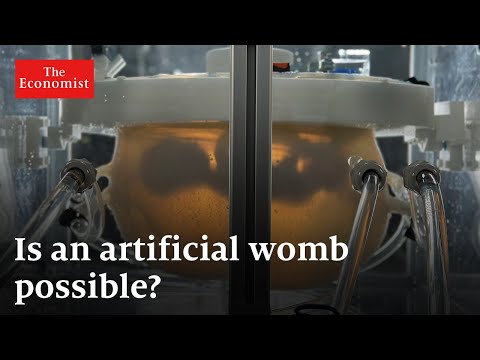
Scientists are hoping to build the world’s first clinically approved artificial womb. The purpose is to save the lives of more premature babies.
00:00 The dangers of premature birth
01:49 How to build an artificial womb
04:17 How does it work?
05:54 When will artificial wombs be rolled out?
Sign up to The Economist’s weekly science newsletter: https://econ.st/46wOpyv
Read our full quarterly report on fertility: https://econ.st/3S1LZnj
Watch our film about the booming surrogacy industry: https://econ.st/3QfjpgX
How to build an artificial womb https://econ.st/3PRLFEW
“Reproductive techno-horror” is a burgeoning genre on screen https://econ.st/3tsEf3t
New ways of making babies are on the horizon https://econ.st/45u8fsM
Mouse “embryoids” can now be grown from stem cells https://econ.st/3tAzZyB
Watch more of our Now & Next series https://econ.st/46f9mgU
,News,News & Politics,QG5WQJXB9vU,UC0p5jTq6Xx_DosDFxVXnWaQ, Politics,Society, channel_UC0p5jTq6Xx_DosDFxVXnWaQ, video_QG5WQJXB9vU,The country’s civil war never ended—it became a fragile stalemate that fell out of the news. A surprise rebel advance (https://www.economist.com/middle-east-and-africa/2024/11/30/syrian-rebels-sweep-into-aleppo-in-an-embarrassing-rout-for-bashar-al-assad?utm_campaign=a.io&utm_medium=audio.podcast.np&utm_source=theintelligence&utm_content=discovery.content.anonymous.tr_shownotes_na-na_article&utm_term=sa.listeners) reveals how the war’s international players are busy facing their own challenges. Our correspondent found it so difficult to disappear from the internet that she gave up (https://www.economist.com/1843/2024/11/08/why-i-gave-up-trying-to-delete-myself-from-the-internet?utm_campaign=a.io&utm_medium=audio.podcast.np&utm_source=theintelligence&utm_content=discovery.content.anonymous.tr_shownotes_na-na_article&utm_term=sa.listeners) (10:30). And who were the stockmarket winners (https://www.economist.com/graphic-detail/2024/11/22/which-shares-have-done-best-from-the-trump-trade?utm_campaign=a.io&utm_medium=audio.podcast.np&utm_source=theintelligence&utm_content=discovery.content.anonymous.tr_shownotes_na-na_article&utm_term=sa.listeners) as “Trump trades” fired up again (16:54)?
Get a world of insights by subscribing to Economist Podcasts+ (https://subscribenow.economist.com/podcasts-plus). For more information about how to access Economist Podcasts+, please visit our FAQs page (https://myaccount.economist.com/s/article/What-is-Economist-Podcasts) or watch our video (https://www.youtube.com/watch?v=Gczo71bg1uY) explaining how to link your account.
Hosted on Acast. See acast.com/privacy (https://acast.com/privacy) for more information.
,News,News & Politics,YC-BK02LzKM,UC0p5jTq6Xx_DosDFxVXnWaQ, Politics,Society, channel_UC0p5jTq6Xx_DosDFxVXnWaQ, video_YC-BK02LzKM,In an interview with Javier Milei (https://www.economist.com/leaders/2024/11/28/javier-milei-my-contempt-for-the-state-is-infinite?utm_campaign=a.io&utm_medium=audio.podcast.np&utm_source=theintelligence&utm_content=discovery.content.anonymous.tr_shownotes_na-na_article&utm_term=sa.listeners), our correspondent probes how far the “anarcho-capitalist” president plans to push his promise to slash spending and reform the state. Can seaweed (https://www.economist.com/business/2024/11/28/could-seaweed-replace-plastic-packaging?utm_campaign=a.io&utm_medium=audio.podcast.np&utm_source=theintelligence&utm_content=discovery.content.anonymous.tr_shownotes_na-na_article&utm_term=sa.listeners) and other fibrous packaging replace plastic (11:51)? And remembering Celeste Caeiro (https://www.economist.com/obituary/2024/11/28/celeste-caeiros-small-gesture-named-a-revolution?utm_campaign=a.io&utm_medium=audio.podcast.np&utm_source=theintelligence&utm_content=discovery.content.anonymous.tr_shownotes_na-na_article&utm_term=sa.listeners), who named the carnation revolution in Portugal in 1974 (18:20).
Listen to what matters most, from global politics and business to science and technology—Subscribe to Economist Podcasts+ (https://subscribenow.economist.com/podcasts-plus)
For more information about how to access Economist Podcasts+, please visit our FAQs page (https://myaccount.economist.com/s/article/What-is-Economist-Podcasts) or watch our video (https://www.youtube.com/watch?v=Gczo71bg1uY) explaining how to link your account.
Hosted on Acast. See acast.com/privacy (https://acast.com/privacy) for more information.
,News,News & Politics,i5MIy_3vplE,UC0p5jTq6Xx_DosDFxVXnWaQ, Politics,Society, channel_UC0p5jTq6Xx_DosDFxVXnWaQ, video_i5MIy_3vplE,Donald Trump (https://www.economist.com/topics/united-states?utm_campaign=a.io&utm_medium=audio.podcast.np&utm_source=theintelligence&utm_content=discovery.content.anonymous.tr_shownotes_na-na_article&utm_term=sa.listeners) had been facing a swathe of lawsuits this year. Now he has won a second term in office, the cases against him are falling away. Why wellness trends may be contributing to iodine deficiency (https://www.economist.com/science-and-technology/2024/11/06/as-wellness-trends-take-off-iodine-deficiency-makes-a-quiet-comeback?utm_campaign=a.io&utm_medium=audio.podcast.np&utm_source=theintelligence&utm_content=discovery.content.anonymous.tr_shownotes_na-na_article&utm_term=sa.listeners) (8:02). And the secrets of elevator etiquette (https://www.economist.com/business/2024/11/21/how-to-behave-in-lifts-an-office-guide?utm_campaign=a.io&utm_medium=audio.podcast.np&utm_source=theintelligence&utm_content=discovery.content.anonymous.tr_shownotes_na-na_article&utm_term=sa.listeners) (13:58).
Listen to what matters most, from global politics and business to science and technology—Subscribe to Economist Podcasts+ (https://subscribenow.economist.com/podcasts-plus)
For more information about how to access Economist Podcasts+, please visit our FAQs page (https://myaccount.economist.com/s/article/What-is-Economist-Podcasts) or watch our video (https://www.youtube.com/watch?v=Gczo71bg1uY) explaining how to link your account.
Hosted on Acast. See acast.com/privacy (https://acast.com/privacy) for more information.
,News,News & Politics,dSvc6GCtC5o,UC0p5jTq6Xx_DosDFxVXnWaQ, Politics,Society, channel_UC0p5jTq6Xx_DosDFxVXnWaQ, video_dSvc6GCtC5o,America feared that letting Ukraine use US weapons (https://www.economist.com/topics/ukraine?utm_campaign=a.io&utm_medium=audio.podcast.np&utm_source=theintelligence&utm_content=discovery.content.anonymous.tr_shownotes_na-na_article&utm_term=sa.listeners) to attack far-off targets in Russia would escalate the conflict. Why has President Joe Biden finally changed his mind? Markets soared (https://www.economist.com/leaders/2024/11/14/whats-about-to-hit-the-world-economy?utm_campaign=a.io&utm_medium=audio.podcast.np&utm_source=theintelligence&utm_content=discovery.content.anonymous.tr_shownotes_na-na_article&utm_term=sa.listeners) when Donald Trump was elected, but the longer-term impact of Trumponomics may be less positive (9:42). And why airships are back (https://www.economist.com/science-and-technology/2024/10/30/airships-may-finally-prove-useful-for-transporting-cargo?utm_campaign=a.io&utm_medium=audio.podcast.np&utm_source=theintelligence&utm_content=discovery.content.anonymous.tr_shownotes_na-na_article&utm_term=sa.listeners) in our skies (18:12).
Listen to what matters most, from global politics and business to science and technology—Subscribe to Economist Podcasts+ (https://subscribenow.economist.com/podcasts-plus)
For more information about how to access Economist Podcasts+, please visit our FAQs page (https://myaccount.economist.com/s/article/What-is-Economist-Podcasts) or watch our video (https://www.youtube.com/watch?v=Gczo71bg1uY) explaining how to link your account.
Hosted on Acast. See acast.com/privacy (https://acast.com/privacy) for more information.
,1,Why are two old, unpopular men the main candidates for the world’s most demanding job? It’s the question John Prideaux, The Economist’s US editor, gets asked the most. And the answer lies in the peculiar politics of the baby boomers.
Since 1992, every American president bar one has been a white man born in the 1940s. That run looks likely to span 36 years - not far off the age of the median American. This cohort was born with aces in their pockets. Their parents defeated Nazism and won the cold war. They hit the jobs market at an unmatched period of wealth creation. They have benefitted from giant leaps in technology, and in racial and gender equality.
And yet, their last act in politics sees the two main parties accusing each other of wrecking American democracy. As the boomers near the end of their political journey, John Prideaux sets out to make sense of their inheritance and their legacy.
Launching July 2024.
To listen to the full series, subscribe to Economist Podcasts+: https://subscribenow.economist.com/podcasts-plus
If you’re already a subscriber to The Economist, you have full access to all our shows as part of your subscription. For more information about how to access Economist Podcasts+, please visit our FAQs page: https://myaccount.economist.com/s/article/What-is-Economist-Podcasts
Or watch our video explaining how to link your account: https://www.youtube.com/watch?v=Gczo71bg1uY
,1,Scientists are hoping to build the world’s first clinically approved artificial womb. The purpose is to save the lives of more premature babies.
00:00 The dangers of premature birth
01:49 How to build an artificial womb
04:17 How does it work?
05:54 When will artificial wombs be rolled out?
Sign up to The Economist’s weekly science newsletter: https://econ.st/46wOpyv
Read our full quarterly report on fertility: https://econ.st/3S1LZnj
Watch our film about the booming surrogacy industry: https://econ.st/3QfjpgX
How to build an artificial womb https://econ.st/3PRLFEW
“Reproductive techno-horror” is a burgeoning genre on screen https://econ.st/3tsEf3t
New ways of making babies are on the horizon https://econ.st/45u8fsM
Mouse “embryoids” can now be grown from stem cells https://econ.st/3tAzZyB
Watch more of our Now & Next series https://econ.st/46f9mgU
,1,Dr. John Newman is a retired U.S. Army intelligence officer who served as a strategic intelligence cryptologic analyst and Military Assistant to the Director at the National Security Agency. John has has spent decades analyzing all 6 million documents on the JFK case and has published 6 book on the topic.
EPISODE LINKS
https://amzn.to/456nIQC
@ghostsofthespywars
https://jfkjmn.com
SPONSORS
VERSO - Go to https://ver.so/koncrete to save 15% on your order.
FOLLOW DANNY JONES
https://www.instagram.com/jonesdanny
https://twitter.com/jonesdanny
LISTEN ON
Spotify - https://open.spotify.com/show/4VTLG0HiIZaCjH9gE6NFPq
Apple - https://itunes.apple.com/podcast/id1441238966
JOIN OUR KULT: https://bit.ly/koncretepatreon
OUTLINE
0:00 - What really happened on 11/22/63
5:40 - Working with Oliver Stone & being contacted by the NSA
18:03 - The biggest CIA mole hunt in history
27:13 - Suppression of John’s books & implications of truth about JFK
43:06 - The CIA's assassination / psychological warfare operations in Europe: Operation Gladio
46:24 - How the Russian sleeper mole in the CIA was activated
1:09:29 - Pyotr Popov
1:14:04 - Tracking the high echelon CIA mole
1:30:07 - Lee Harvey Oswald
1:32:25 - The Army General who wanted Armageddon: Lyman Lemnitzer
1:38:44 - The ‘Trojan Horse’ inside the Kennedy family: Maxwell Taylor
1:55:14 - JFK’s plan to pull out of Vietnam
2:05:03 - The military coup leading up to JFK’s a$$in@tion
2:17:22 - Lee Harvey Oswald’s meetings in Mexico in 1963
2:36:10 - The KGB defector who claimed 2 former US presidents knew about the plan to take out JFK
2:42:40 - The missing letter Oswald wrote to CIA from Minsk
2:48:18 - The CIA mole inside Martin Luther King’s group
3:01:31 - John’s conclusion on JFK
3:04:52 - Kennedy’s speech on secret societies
3:09:54 - John’s involvement with Oliver Stone’s latest documentary ‘JFK Revisited’
KONCRETE
http://twitter.com/koncrete
http://instagram.com/koncrete
http://facebook.com/koncreteinc