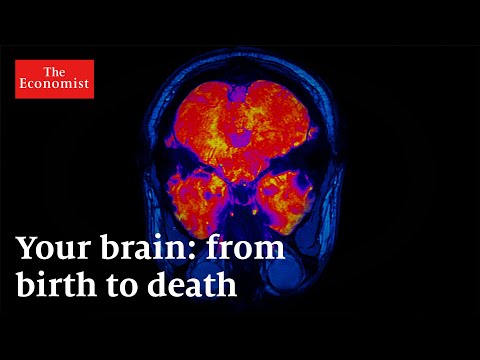
As the most complex organ in your body, your brain changes radically throughout your life. Starting from before birth and continuing even after you've died. This is what happens to your brain as you age.
00:00 - What happens to your brain when you age?
00:32 - In the womb
01:03 - Childhood
03:19 - Teenage years
04:48 - Early adulthood
05:27 - Middle age
07:04 - Later life
07:36 - Death
Sign up to The Economist’s daily newsletter: https://econ.st/3QAawvI
Is there a genetic link between endometriosis and the brain?: https://econ.st/46u9Q31
Even doctors can struggle to diagnose concussions: https://econ.st/3RlFfQP
Artificial brains are helping scientists study the real thing: https://econ.st/3Plo6UN
A big advance in mapping the structure of the brain: https://econ.st/48sx6jJ
Studying broken chromosomes can illuminate neuroscience: https://econ.st/3rff7we
The troubling link between contact sports and long-term brain injuries, listen to our science and technology podcast, Babbage to find out more: https://econ.st/3rgN3Zp
Neurons are not the only brain cells that think: https://econ.st/3PjU1EN
Are brain implants the future of computing? Watch our film to find out: https://econ.st/3ZxzNfP
How adult brains learn the new without forgetting the old: https://econ.st/3EDJO1b
Becoming a father shrinks your cerebrum: https://econ.st/3EH67Df
How to keep the brain healthy: https://econ.st/3PBe3w4
,1,The country’s civil war never ended—it became a fragile stalemate that fell out of the news. A surprise rebel advance (https://www.economist.com/middle-east-and-africa/2024/11/30/syrian-rebels-sweep-into-aleppo-in-an-embarrassing-rout-for-bashar-al-assad?utm_campaign=a.io&utm_medium=audio.podcast.np&utm_source=theintelligence&utm_content=discovery.content.anonymous.tr_shownotes_na-na_article&utm_term=sa.listeners) reveals how the war’s international players are busy facing their own challenges. Our correspondent found it so difficult to disappear from the internet that she gave up (https://www.economist.com/1843/2024/11/08/why-i-gave-up-trying-to-delete-myself-from-the-internet?utm_campaign=a.io&utm_medium=audio.podcast.np&utm_source=theintelligence&utm_content=discovery.content.anonymous.tr_shownotes_na-na_article&utm_term=sa.listeners) (10:30). And who were the stockmarket winners (https://www.economist.com/graphic-detail/2024/11/22/which-shares-have-done-best-from-the-trump-trade?utm_campaign=a.io&utm_medium=audio.podcast.np&utm_source=theintelligence&utm_content=discovery.content.anonymous.tr_shownotes_na-na_article&utm_term=sa.listeners) as “Trump trades” fired up again (16:54)?
Get a world of insights by subscribing to Economist Podcasts+ (https://subscribenow.economist.com/podcasts-plus). For more information about how to access Economist Podcasts+, please visit our FAQs page (https://myaccount.economist.com/s/article/What-is-Economist-Podcasts) or watch our video (https://www.youtube.com/watch?v=Gczo71bg1uY) explaining how to link your account.
Hosted on Acast. See acast.com/privacy (https://acast.com/privacy) for more information.
,1,In an interview with Javier Milei (https://www.economist.com/leaders/2024/11/28/javier-milei-my-contempt-for-the-state-is-infinite?utm_campaign=a.io&utm_medium=audio.podcast.np&utm_source=theintelligence&utm_content=discovery.content.anonymous.tr_shownotes_na-na_article&utm_term=sa.listeners), our correspondent probes how far the “anarcho-capitalist” president plans to push his promise to slash spending and reform the state. Can seaweed (https://www.economist.com/business/2024/11/28/could-seaweed-replace-plastic-packaging?utm_campaign=a.io&utm_medium=audio.podcast.np&utm_source=theintelligence&utm_content=discovery.content.anonymous.tr_shownotes_na-na_article&utm_term=sa.listeners) and other fibrous packaging replace plastic (11:51)? And remembering Celeste Caeiro (https://www.economist.com/obituary/2024/11/28/celeste-caeiros-small-gesture-named-a-revolution?utm_campaign=a.io&utm_medium=audio.podcast.np&utm_source=theintelligence&utm_content=discovery.content.anonymous.tr_shownotes_na-na_article&utm_term=sa.listeners), who named the carnation revolution in Portugal in 1974 (18:20).
Listen to what matters most, from global politics and business to science and technology—Subscribe to Economist Podcasts+ (https://subscribenow.economist.com/podcasts-plus)
For more information about how to access Economist Podcasts+, please visit our FAQs page (https://myaccount.economist.com/s/article/What-is-Economist-Podcasts) or watch our video (https://www.youtube.com/watch?v=Gczo71bg1uY) explaining how to link your account.
Hosted on Acast. See acast.com/privacy (https://acast.com/privacy) for more information.
,1,Donald Trump (https://www.economist.com/topics/united-states?utm_campaign=a.io&utm_medium=audio.podcast.np&utm_source=theintelligence&utm_content=discovery.content.anonymous.tr_shownotes_na-na_article&utm_term=sa.listeners) had been facing a swathe of lawsuits this year. Now he has won a second term in office, the cases against him are falling away. Why wellness trends may be contributing to iodine deficiency (https://www.economist.com/science-and-technology/2024/11/06/as-wellness-trends-take-off-iodine-deficiency-makes-a-quiet-comeback?utm_campaign=a.io&utm_medium=audio.podcast.np&utm_source=theintelligence&utm_content=discovery.content.anonymous.tr_shownotes_na-na_article&utm_term=sa.listeners) (8:02). And the secrets of elevator etiquette (https://www.economist.com/business/2024/11/21/how-to-behave-in-lifts-an-office-guide?utm_campaign=a.io&utm_medium=audio.podcast.np&utm_source=theintelligence&utm_content=discovery.content.anonymous.tr_shownotes_na-na_article&utm_term=sa.listeners) (13:58).
Listen to what matters most, from global politics and business to science and technology—Subscribe to Economist Podcasts+ (https://subscribenow.economist.com/podcasts-plus)
For more information about how to access Economist Podcasts+, please visit our FAQs page (https://myaccount.economist.com/s/article/What-is-Economist-Podcasts) or watch our video (https://www.youtube.com/watch?v=Gczo71bg1uY) explaining how to link your account.
Hosted on Acast. See acast.com/privacy (https://acast.com/privacy) for more information.
,1,America feared that letting Ukraine use US weapons (https://www.economist.com/topics/ukraine?utm_campaign=a.io&utm_medium=audio.podcast.np&utm_source=theintelligence&utm_content=discovery.content.anonymous.tr_shownotes_na-na_article&utm_term=sa.listeners) to attack far-off targets in Russia would escalate the conflict. Why has President Joe Biden finally changed his mind? Markets soared (https://www.economist.com/leaders/2024/11/14/whats-about-to-hit-the-world-economy?utm_campaign=a.io&utm_medium=audio.podcast.np&utm_source=theintelligence&utm_content=discovery.content.anonymous.tr_shownotes_na-na_article&utm_term=sa.listeners) when Donald Trump was elected, but the longer-term impact of Trumponomics may be less positive (9:42). And why airships are back (https://www.economist.com/science-and-technology/2024/10/30/airships-may-finally-prove-useful-for-transporting-cargo?utm_campaign=a.io&utm_medium=audio.podcast.np&utm_source=theintelligence&utm_content=discovery.content.anonymous.tr_shownotes_na-na_article&utm_term=sa.listeners) in our skies (18:12).
Listen to what matters most, from global politics and business to science and technology—Subscribe to Economist Podcasts+ (https://subscribenow.economist.com/podcasts-plus)
For more information about how to access Economist Podcasts+, please visit our FAQs page (https://myaccount.economist.com/s/article/What-is-Economist-Podcasts) or watch our video (https://www.youtube.com/watch?v=Gczo71bg1uY) explaining how to link your account.
Hosted on Acast. See acast.com/privacy (https://acast.com/privacy) for more information.
,,2CpKXr7K6Bc,, Military,Society, channel_UC0p5jTq6Xx_DosDFxVXnWaQ, video_2CpKXr7K6Bc,By reshaping the balance between humans and technology on the battlefield, cheap drones are transforming warfare in Ukraine. Shashank Joshi, our defence editor, explains how.
Sign up to our defence newsletter: https://econ.st/4dgzw67
How cheap drones are transforming warfare in Ukraine: https://econ.st/4eR1Ayr
What are FPV drones?: https://econ.st/4hbUHcL
,1,As the most complex organ in your body, your brain changes radically throughout your life. Starting from before birth and continuing even after you've died. This is what happens to your brain as you age.
00:00 - What happens to your brain when you age?
00:32 - In the womb
01:03 - Childhood
03:19 - Teenage years
04:48 - Early adulthood
05:27 - Middle age
07:04 - Later life
07:36 - Death
Sign up to The Economist’s daily newsletter: https://econ.st/3QAawvI
Is there a genetic link between endometriosis and the brain?: https://econ.st/46u9Q31
Even doctors can struggle to diagnose concussions: https://econ.st/3RlFfQP
Artificial brains are helping scientists study the real thing: https://econ.st/3Plo6UN
A big advance in mapping the structure of the brain: https://econ.st/48sx6jJ
Studying broken chromosomes can illuminate neuroscience: https://econ.st/3rff7we
The troubling link between contact sports and long-term brain injuries, listen to our science and technology podcast, Babbage to find out more: https://econ.st/3rgN3Zp
Neurons are not the only brain cells that think: https://econ.st/3PjU1EN
Are brain implants the future of computing? Watch our film to find out: https://econ.st/3ZxzNfP
How adult brains learn the new without forgetting the old: https://econ.st/3EDJO1b
Becoming a father shrinks your cerebrum: https://econ.st/3EH67Df
How to keep the brain healthy: https://econ.st/3PBe3w4