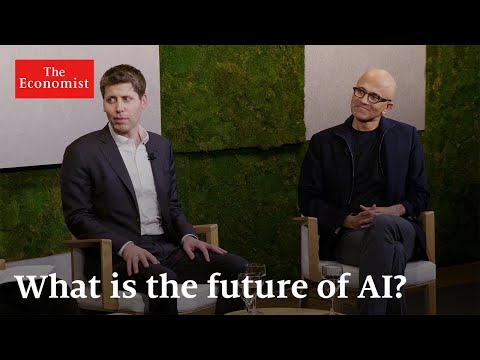
Sam Altman, CEO of OpenAI, and Satya Nadella, CEO of Microsoft, speak to The Economist’s editor-in-chief, Zanny Minton Beddoes, about what the future of AI will really look like.
00:00 Sam Altman and Satya Nadella talk to The Economist
00:25 What’s next for ChatGPT?
1:33 How dangerous is AGI?
2:32 AI regulation
Sign up to The Economist’s daily newsletter: https://econ.st/3QAawvI
Read more of our AI coverage: https://econ.st/3O9fK2v
Watch the full interview here: https://econ.st/3O7qXk5
Read our write up of the interview: https://econ.st/3HpwbUL
,News,News & Politics,QG5WQJXB9vU,UC0p5jTq6Xx_DosDFxVXnWaQ, Politics,Society, channel_UC0p5jTq6Xx_DosDFxVXnWaQ, video_QG5WQJXB9vU,The country’s civil war never ended—it became a fragile stalemate that fell out of the news. A surprise rebel advance (https://www.economist.com/middle-east-and-africa/2024/11/30/syrian-rebels-sweep-into-aleppo-in-an-embarrassing-rout-for-bashar-al-assad?utm_campaign=a.io&utm_medium=audio.podcast.np&utm_source=theintelligence&utm_content=discovery.content.anonymous.tr_shownotes_na-na_article&utm_term=sa.listeners) reveals how the war’s international players are busy facing their own challenges. Our correspondent found it so difficult to disappear from the internet that she gave up (https://www.economist.com/1843/2024/11/08/why-i-gave-up-trying-to-delete-myself-from-the-internet?utm_campaign=a.io&utm_medium=audio.podcast.np&utm_source=theintelligence&utm_content=discovery.content.anonymous.tr_shownotes_na-na_article&utm_term=sa.listeners) (10:30). And who were the stockmarket winners (https://www.economist.com/graphic-detail/2024/11/22/which-shares-have-done-best-from-the-trump-trade?utm_campaign=a.io&utm_medium=audio.podcast.np&utm_source=theintelligence&utm_content=discovery.content.anonymous.tr_shownotes_na-na_article&utm_term=sa.listeners) as “Trump trades” fired up again (16:54)?
Get a world of insights by subscribing to Economist Podcasts+ (https://subscribenow.economist.com/podcasts-plus). For more information about how to access Economist Podcasts+, please visit our FAQs page (https://myaccount.economist.com/s/article/What-is-Economist-Podcasts) or watch our video (https://www.youtube.com/watch?v=Gczo71bg1uY) explaining how to link your account.
Hosted on Acast. See acast.com/privacy (https://acast.com/privacy) for more information.
,News,News & Politics,YC-BK02LzKM,UC0p5jTq6Xx_DosDFxVXnWaQ, Politics,Society, channel_UC0p5jTq6Xx_DosDFxVXnWaQ, video_YC-BK02LzKM,In an interview with Javier Milei (https://www.economist.com/leaders/2024/11/28/javier-milei-my-contempt-for-the-state-is-infinite?utm_campaign=a.io&utm_medium=audio.podcast.np&utm_source=theintelligence&utm_content=discovery.content.anonymous.tr_shownotes_na-na_article&utm_term=sa.listeners), our correspondent probes how far the “anarcho-capitalist” president plans to push his promise to slash spending and reform the state. Can seaweed (https://www.economist.com/business/2024/11/28/could-seaweed-replace-plastic-packaging?utm_campaign=a.io&utm_medium=audio.podcast.np&utm_source=theintelligence&utm_content=discovery.content.anonymous.tr_shownotes_na-na_article&utm_term=sa.listeners) and other fibrous packaging replace plastic (11:51)? And remembering Celeste Caeiro (https://www.economist.com/obituary/2024/11/28/celeste-caeiros-small-gesture-named-a-revolution?utm_campaign=a.io&utm_medium=audio.podcast.np&utm_source=theintelligence&utm_content=discovery.content.anonymous.tr_shownotes_na-na_article&utm_term=sa.listeners), who named the carnation revolution in Portugal in 1974 (18:20).
Listen to what matters most, from global politics and business to science and technology—Subscribe to Economist Podcasts+ (https://subscribenow.economist.com/podcasts-plus)
For more information about how to access Economist Podcasts+, please visit our FAQs page (https://myaccount.economist.com/s/article/What-is-Economist-Podcasts) or watch our video (https://www.youtube.com/watch?v=Gczo71bg1uY) explaining how to link your account.
Hosted on Acast. See acast.com/privacy (https://acast.com/privacy) for more information.
,News,News & Politics,i5MIy_3vplE,UC0p5jTq6Xx_DosDFxVXnWaQ, Politics,Society, channel_UC0p5jTq6Xx_DosDFxVXnWaQ, video_i5MIy_3vplE,Donald Trump (https://www.economist.com/topics/united-states?utm_campaign=a.io&utm_medium=audio.podcast.np&utm_source=theintelligence&utm_content=discovery.content.anonymous.tr_shownotes_na-na_article&utm_term=sa.listeners) had been facing a swathe of lawsuits this year. Now he has won a second term in office, the cases against him are falling away. Why wellness trends may be contributing to iodine deficiency (https://www.economist.com/science-and-technology/2024/11/06/as-wellness-trends-take-off-iodine-deficiency-makes-a-quiet-comeback?utm_campaign=a.io&utm_medium=audio.podcast.np&utm_source=theintelligence&utm_content=discovery.content.anonymous.tr_shownotes_na-na_article&utm_term=sa.listeners) (8:02). And the secrets of elevator etiquette (https://www.economist.com/business/2024/11/21/how-to-behave-in-lifts-an-office-guide?utm_campaign=a.io&utm_medium=audio.podcast.np&utm_source=theintelligence&utm_content=discovery.content.anonymous.tr_shownotes_na-na_article&utm_term=sa.listeners) (13:58).
Listen to what matters most, from global politics and business to science and technology—Subscribe to Economist Podcasts+ (https://subscribenow.economist.com/podcasts-plus)
For more information about how to access Economist Podcasts+, please visit our FAQs page (https://myaccount.economist.com/s/article/What-is-Economist-Podcasts) or watch our video (https://www.youtube.com/watch?v=Gczo71bg1uY) explaining how to link your account.
Hosted on Acast. See acast.com/privacy (https://acast.com/privacy) for more information.
,News,News & Politics,dSvc6GCtC5o,UC0p5jTq6Xx_DosDFxVXnWaQ, Politics,Society, channel_UC0p5jTq6Xx_DosDFxVXnWaQ, video_dSvc6GCtC5o,America feared that letting Ukraine use US weapons (https://www.economist.com/topics/ukraine?utm_campaign=a.io&utm_medium=audio.podcast.np&utm_source=theintelligence&utm_content=discovery.content.anonymous.tr_shownotes_na-na_article&utm_term=sa.listeners) to attack far-off targets in Russia would escalate the conflict. Why has President Joe Biden finally changed his mind? Markets soared (https://www.economist.com/leaders/2024/11/14/whats-about-to-hit-the-world-economy?utm_campaign=a.io&utm_medium=audio.podcast.np&utm_source=theintelligence&utm_content=discovery.content.anonymous.tr_shownotes_na-na_article&utm_term=sa.listeners) when Donald Trump was elected, but the longer-term impact of Trumponomics may be less positive (9:42). And why airships are back (https://www.economist.com/science-and-technology/2024/10/30/airships-may-finally-prove-useful-for-transporting-cargo?utm_campaign=a.io&utm_medium=audio.podcast.np&utm_source=theintelligence&utm_content=discovery.content.anonymous.tr_shownotes_na-na_article&utm_term=sa.listeners) in our skies (18:12).
Listen to what matters most, from global politics and business to science and technology—Subscribe to Economist Podcasts+ (https://subscribenow.economist.com/podcasts-plus)
For more information about how to access Economist Podcasts+, please visit our FAQs page (https://myaccount.economist.com/s/article/What-is-Economist-Podcasts) or watch our video (https://www.youtube.com/watch?v=Gczo71bg1uY) explaining how to link your account.
Hosted on Acast. See acast.com/privacy (https://acast.com/privacy) for more information.
,1,Why are two old, unpopular men the main candidates for the world’s most demanding job? It’s the question John Prideaux, The Economist’s US editor, gets asked the most. And the answer lies in the peculiar politics of the baby boomers.
Since 1992, every American president bar one has been a white man born in the 1940s. That run looks likely to span 36 years - not far off the age of the median American. This cohort was born with aces in their pockets. Their parents defeated Nazism and won the cold war. They hit the jobs market at an unmatched period of wealth creation. They have benefitted from giant leaps in technology, and in racial and gender equality.
And yet, their last act in politics sees the two main parties accusing each other of wrecking American democracy. As the boomers near the end of their political journey, John Prideaux sets out to make sense of their inheritance and their legacy.
Launching July 2024.
To listen to the full series, subscribe to Economist Podcasts+: https://subscribenow.economist.com/podcasts-plus
If you’re already a subscriber to The Economist, you have full access to all our shows as part of your subscription. For more information about how to access Economist Podcasts+, please visit our FAQs page: https://myaccount.economist.com/s/article/What-is-Economist-Podcasts
Or watch our video explaining how to link your account: https://www.youtube.com/watch?v=Gczo71bg1uY
,1,Guest narrated by the fantastic @LEMMiNO! Sponsored by Ground News: head to https://ground.news/melodysheep to see through misleading media narratives and find common ground. Use my link to get 40% off unlimited access this month.
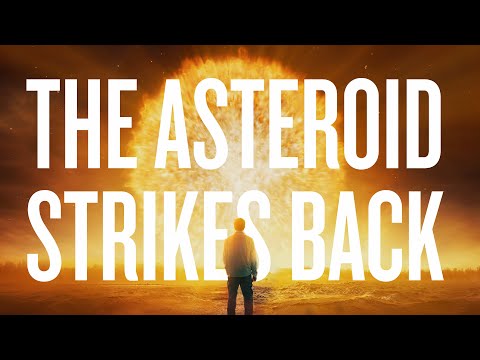
If the asteroid that killed the dinosaurs struck again today? Would humans survive? Or would we go the way of the dinosaurs?
Join me on a wild tour through a hypothetical apocalypse -- and see what it would take for humanity to cling on through the worst disaster in the last 250 million years.
Featuring LEMMiNO -- a Swedish filmmaker who runs an incredible youtube channel of his own -- if you haven't seen it, please check out his awesome work at https://youtube.com/LEMMiNO
---------------
Story, visual effects, music & sound by melodysheep (John D. Boswell)
Narrated by LEMMiNO
Additional VFX:
Aaron Waldschmidt
Samuel Krug
Ignis Santander
Job Guidos
Supported by:
Juan Benet
James Upsher
Morrison Waud
Matthew Brown
Tabloid A
Angela Kilic-Cave
Special thanks to my $50+ Patreon Supporters:
Kimi Ushida
Frank Buschmann
Romain Gilliot
Serenelove520
Naomi Augustine
Brandon Sanders
Derick Yan
Caleb Levesque
David Balland
Michael Denny
JM_Borg
David August
Jeremiah Tims
Joan Meier
Robert Leiper
David Rovira
Jake Rodio
Mackenzie Moore
bluetifulangel
WJSBUTLER & CO
Alex Zhang
Sebastián Soto
Andrew Williams
And to my $10 Patreon supporters – to numerous to list here!
https://www.dropbox.com/s/5iouwg2zf3blxa5/TASB_Supporters.rtf?dl=0
,1,Since his election last year, President Javier Milei has enjoyed some economic and political wins in Argentina. But his toughest fight (https://www.economist.com/leaders/2024/06/19/javier-mileis-next-move-could-make-his-presidency-or-break-it) is yet to come. On Britain’s general election trail, our correspondent found voters less keen on the prospect of a Labour victory than on punishing the Conservative party (https://www.economist.com/britain/2024/06/18/britains-conservatives-rule-the-thames-estuary-not-for-long) at the polls (10:00). And remembering Birubala Rabha (https://www.economist.com/obituary/2024/06/20/birubala-rabha-fought-to-end-the-stigmatisation-of-women), who campaigned against witch-hunting in India (18.35).
Listen to what matters most, from global politics and business to science and technology—Subscribe to Economist Podcasts+ (https://subscribenow.economist.com/podcasts-plus)
For more information about how to access Economist Podcasts+, please visit our FAQs page (https://myaccount.economist.com/s/article/What-is-Economist-Podcasts) or watch our video (https://www.youtube.com/watch?v=Gczo71bg1uY) explaining how to link your account.
Hosted on Acast. See acast.com/privacy (https://acast.com/privacy) for more information.
,1,President Trump answers on question on withdrawing forces from Syria and why he's "siding with an authoritarian leader and not our Kurdish allies?" President Trump responds, "I'm not siding with anybody…Syria was supposed to be a short-term hit." Full video here: https://cs.pn/2AMQoSb
C-SPAN
https://www.youtube.com/channel/UCb--64Gl51jIEVE-GLDAVTg
Subscribe and hit the bell, video feeds from over 150 sources!
,1,Sam Altman, CEO of OpenAI, and Satya Nadella, CEO of Microsoft, speak to The Economist’s editor-in-chief, Zanny Minton Beddoes, about what the future of AI will really look like.
00:00 Sam Altman and Satya Nadella talk to The Economist
00:25 What’s next for ChatGPT?
1:33 How dangerous is AGI?
2:32 AI regulation
Sign up to The Economist’s daily newsletter: https://econ.st/3QAawvI
Read more of our AI coverage: https://econ.st/3O9fK2v
Watch the full interview here: https://econ.st/3O7qXk5
Read our write up of the interview: https://econ.st/3HpwbUL
,1,When massive stars explode in violent supernovas, they wipe out any nearby planets — but sometimes, the leftovers debris from this catastrophe can cool and condense, eventually forming entirely new worlds: zombie planets, built from the ashes of the dead.
2,300 light years away, an ancient pulsar harbors 3 potential zombie worlds: Draugr, Phobetor, and Poltergeist. The intense X-ray radiation from their dead star, combined with the strobing light of the spinning pulsar poring over the surface, would make these planets appear truly alien to anyone who dares to visit.
A clip from THE SIGHTS OF SPACE: https://www.youtube.com/watch?v=HTHj_pvEYYE