The United States Supreme Court ruled that classroom diversity is no longer a compelling interest to justify using race in college admissions, overturning past precedents that had upheld affirmative action for decades. Race alone can no longer act as an adequate substitute for the diversity of perspectives and ideas that students bring. Race-based affirmative action now faces new legal vulnerabilities, including potential lawsuits against other private and public institutions.
,,fw4L6m6oVZs,UCzWwWbbKHg4aodl0S35R6XA, Business,Politics,Society, channel_UCzWwWbbKHg4aodl0S35R6XA, video_fw4L6m6oVZs,Hoover Institution senior fellow Elizabeth Economy and Rhodium Group Co-founder Daniel Rosen discuss the shift in Chinese economic policy under Xi Jinping, particularly his decision to move away from heavy investment in the property sector and focus on the "three new industries"—battery technology, electric vehicles (EVs), energy storage, and AI-driven advanced manufacturing.
#China #CCP #XiJinping #PRC #USA #America #UnitedStates #Trade #Economics #Tariffs #Politics #Geopolitics #Trump #DonaldTrump #EV #ElectricVehicle #Property #AI #ArtificialIntelligence ##Democracy #Battery #Technology #Taiwan #Philipines #HongKong #SouthChinaSea #Trade #TradeWar #Shorts #YouTubeShorts #ShortsVideo #ShortVideo
,,NuWFYdRqkJo,UCzWwWbbKHg4aodl0S35R6XA, Politics,Society, channel_UCzWwWbbKHg4aodl0S35R6XA, video_NuWFYdRqkJo,On #ChinaConsidered with host Elizabeth Economy, Matt Pottinger discusses how a second Trump administration might approach China policy. Pottinger explains that Trump may continue where he left off, largely utilizing the US-China trade relationship as a proxy for the problems in the broader relationship between the countries.
#China #CCP #XiJinping #PRC #USA #America #UnitedStates #Trade #Economics #Tariffs #Politics #Geopolitics #Trump #DonaldTrump #Democracy #Taiwan #Philipines #HongKong #SouthChinaSea #Trade #TradeWar #Shorts #YouTubeShorts #ShortsVideo #ShortVideo
,1,Volcanic rocks contain small bits of iron oxide that get magnetised in the direction of the Earth's magnetic field as they cool. Comparing rocks of different ages reveals the magnetic history of our planet.
Watch the full second lecture of the series: https://www.rigb.org/christmas-lectures/watch/1995/planet-earth-an-explorers-guide/secrets-of-the-deep?utm_source=youtube&utm_medium=social&utm_term=description
James Jackson gave the 1995 Christmas Lectures "Planet Earth: An Explorer's Guide" about the inner workings of planet Earth.
The second lecture "Secrets of the Deep", where this clip is from, is about the crucial role plate tectonics play in the structure of our oceans and continents.
Watch the full series:
https://www.rigb.org/christmas-lectures/watch/1995/planet-earth-an-explorers-guide?utm_source=youtube&utm_medium=social&utm_term=description
Christmas Lectures are a popular children's science show broadcast every year on the BBC. As such they fall under YouTube's 'Made for Kids' category, which means that some common features are disabled on this video, such as comments, cards and end screens.
The Ri is on Twitter: http://twitter.com/ri_science
and Facebook: http://www.facebook.com/royalinstitution
and Tumblr: http://ri-science.tumblr.com/
Our editorial policy: http://www.rigb.org/home/editorial-policy
Subscribe for the latest science videos: http://bit.ly/RiNewsletter
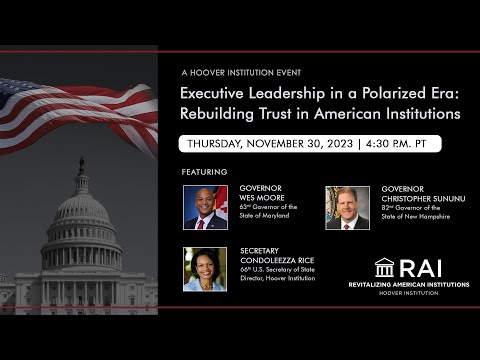
,1,On Thursday, November 30, 2023 the Hoover Institution hosted Governors Wes Moore (D-Maryland) and Christopher Sununu (R-New Hampshire) in conversation with Hoover Institution Director Condoleezza Rice to offer perspectives on the state of American institutions. In a bipartisanship spirit, the governors and Director Rice shared insights on how trust in and the efficacy of governmental institutions can be improved as well as the challenges of doing so in a polarized environment. Panelists shared their perspectives as chief executives and weighed in on reforms to improve democracy at all levels of government.
For more information visit, https://www.hoover.org/events/executive-leadership-polarized-era-rebuilding-trust-american-institutions.
ABOUT THE SPEAKERS
Governor Wes Moore is the 63rd Governor of the state of Maryland and is the state’s first Black Governor. Moore earned an Associate’s degree from Valley Forge Military Academy and College and was commissioned as a second lieutenant in the U.S. Army. He earned his Bachelor’s in international relations and economics at Johns Hopkins University in Baltimore, where he graduated Phi Beta Kappa and was the university’s first Black Rhodes Scholar. Moore served as a captain in the 82nd Airborne Division in Afghanistan and was the CEO of the Robin Hood Foundation. He also worked in finance with Deutsche Bank in London and with Citigroup in New York. He and his wife Dawn Flythe Moore have two children.
Governor Christopher Sununu
Governor Christopher Sununu is the 82nd Governor of the State of New Hampshire and is currently serving his fourth term, receiving in 2020 more votes ever than any candidate in state history. With Governor Sununu's leadership, New Hampshire is ranked the #1 state in the country for personal freedoms by Cato Institute. Chris grew up in Salem, NH. He graduated from Massachusetts Institute of Technology (M.I.T.) with a BS in Civil/Environmental Engineering. As an environmental engineer, Chris worked for ten years cleaning up hazardous waste sites across the country. Governor Sununu lives in Newfields with his wife, Valerie, and their three children.
condoleezza rice image
Condoleezza Rice is the Tad and Dianne Taube Director of the Hoover Institution and a Senior Fellow on Public Policy. She is the Denning Professor in Global Business and the Economy at the Stanford Graduate School of Business. In addition, she is a founding partner of Rice, Hadley, Gates & Manuel LLC, an international strategic consulting firm.
ABOUT RAI
The Center for Revitalizing American Institutions in multiple ways affirms the purpose for which Herbert Hoover created the Hoover Institution. Through scholarship, policy analysis, and dissemination of findings, RAI will help the nation meet the current existential challenges to our institutions. By giving definition to the problem and approaching it holistically, RAI is a resource for improving the current situation and encouraging an informed and active citizenry.
For more information on the Center for Revitalizing Institutions, visit https://www.hoover.org/research-teams/center-revitalizing-american-institutions.
,1,The United States Supreme Court ruled that classroom diversity is no longer a compelling interest to justify using race in college admissions, overturning past precedents that had upheld affirmative action for decades. Race alone can no longer act as an adequate substitute for the diversity of perspectives and ideas that students bring. Race-based affirmative action now faces new legal vulnerabilities, including potential lawsuits against other private and public institutions.
,1,Clip from the Joe Rogan Experience #1945 with Eric Weinstein discussing the war between Russia and Ukraine, and the possibility of World War 3.
#joerogan #jre #joeroganexperience #russiaukraine
,1,January 31, 2024
Hoover Institution | Stanford University
Jesús Fernández-Villaverde, the Howard Marks Presidential Professor of Economics at the University of Pennsylvania, discussed “The Wealth of Working Nations,” a paper with Gustavo Ventura (Arizona State University) and Wen Yao (Tsinghua University).
PARTICIPANTS
Jesús Fernández-Villaverde, John Taylor, Annelise Anderson, Michael Boskin, Doug Branch, Pedro Carvalho, John Cochrane, Chris Dauer, Steve Davis, Sebastian Di Tella, David Fedor, Jared Franz, Bob Hall, Adele Hayutin, Gregory Hess, Laurie Hodrick, Robert Hodrick, Chad Jones, Ken Judd, Matthew Kahn, Pete Klenow, Evan Koenig, David Laidler, Oliver Landmann, John Lipsky, Lee Ohanian, Robert Oster, Radek Paluszynski, Elena Pastorino, Paul Peterson, Alvin Rabushka, Valerie Ramey, Richard Sousa, Tom Stephenson, Jack Tatom, George Tavlas, Yevgeniy Teryoshin, Chris Tonetti, Victor Valcarcel, Gustavo Ventura
ISSUES DISCUSSED
Jesús Fernández-Villaverde, the Howard Marks Presidential Professor of Economics at the University of Pennsylvania, discussed “The Wealth of Working Nations,” a paper with Gustavo Ventura (Arizona State University) and Wen Yao (Tsinghua University).
John Taylor, the Mary and Robert Raymond Professor of Economics at Stanford University and the George P. Shultz Senior Fellow in Economics at the Hoover Institution, was the moderator.
PAPER SUMMARY
Due to population aging, GDP growth per capita and GDP growth per working-age adult have become quite different among many advanced economies over the last several decades. Countries whose GDP growth per capita performance has been lackluster, like Japan, have done surprisingly well in terms of GDP growth per working-age adult. Indeed, from 1998 to 2019, Japan has grown slightly faster than the U.S. in terms of per working-age adult: an accumulated 31.9% vs. 29.5%. Furthermore, many advanced economies appear to be on parallel balanced growth trajectories in terms of working-age adults despite important differences in levels. Motivated by this observation, we calibrate a standard neoclassical growth model in which the growth of the working-age adult population varies in line with the data for each economy. Despite the underlying demographic differences, the calibrated model tracks output per workingage adult in most economies of our sample. Our results imply that the growth behavior of mature, aging economies is not puzzling from a theoretical perspective.
To read the paper, click the following link
https://www.sas.upenn.edu/%7Ejesusfv/Wealth_Working_Nations.pdf
To read the slides, click the following link
https://www.hoover.org/sites/default/files/2024-02/Slides_Hoover.pdf