Clip from the Joe Rogan Experience #1945 with Eric Weinstein discussing UFO's and whether they are studying or observing us humans.
#joerogan #jre #joeroganexperience #ufo
,1,Clip from the Joe Rogan Experience #1945 with Eric Weinstein discussing UFO's and long distance space travel
#joerogan #jre #joeroganexperience #ufo
,1,Clip from the Joe Rogan Experience #1945 with Eric Weinstein discussing the war between Russia and Ukraine, and the possibility of World War 3.
#joerogan #jre #joeroganexperience #russiaukraine
,1,Biblical Hebrew partial scholarship: https://goo.gl/AK3MUw
For centuries, the Holy Bible has been a source of inspiration for people all over the world. It is the most widely distributed book today. The Bible is a part of our modern world and has influenced the foundations of Western culture. The Israel Institute of Biblical Studies aims to make the Bible accessible, live from Israel, to people around the world. Through Biblical study and language courses students connect with teachers in the Holy Land to learn the original languages of the Old and New Testaments. This allows them to interpret the holy texts themselves, while discovering the ancient land of the Bible where the stories took place. Find out more about the Old and New Testaments through the Jewish studies, and the connection between Judaism and Christianity.
Students benefit from a full educational experience with an entirely new dimension that immerses them in the Bible's texts, land, people, language, and culture. Our supportive and social learning environment ensures that students are academically challenged through the in-depth study of the Bible. Professional and passionate teachers from the Holy Land of Israel lead each online course, including: Exploring the Biblical Land of Israel, Discovering the Hebrew Bible, Modern Hebrew, Biblical Hebrew and Biblical Greek. Learn the ancient languages of the original Bible, the Torah, and dive into the scriptures to learn the original meaning of the holy texts! The Israel Institute of Biblical Studies has been recognized by the Hebrew University of Jerusalem and the world as a prestigious academy for the study of Biblical languages, culture, and history.
Did you know that the Biblical Hebrew alphabet is different than the Modern Hebrew alphabet? Even Biblical Hebrew verbs, phrases, punctuation, syntax, and more are all different, and important to understanding ancient Holy Scriptures. The Israel Institute of Biblical Studies offers students the best teachers and a strong and supportive community combined with advanced technology that makes our live courses available to anyone anywhere in the world. Students can learn in their own time and even in their own language.
Uncover hidden meanings and deepen your understanding of the Holy Scriptures - Biblical Hebrew partial scholarship: https://goo.gl/AK3MUw
,1,November 8, 2023
Hoover Institution | Stanford University
Jennifer Burns, research fellow at the Hoover Institution and associate professor of History at Stanford University, discussed her forthcoming book, Milton Friedman: The Last Conservative.
https://www.hoover.org/research/milton-friedman-last-conservative
PARTICIPANTS
Jennifer Burns, John Taylor, Annelise Anderson, Uschi Backes-Gellner, Michael Boskin, Pedro Carvalho, John Cochrane, Bradley Combest, Steven Davis, Randi Dewitty, Sami Diaf, Christopher Erceg, David Fedor, Jared Franz, Bob Hall, Kevin Hassett, Robert Hetzel, Robert Hodrick, Doug Irwin, Ken Judd, Matthew Kahn, Timothy Kane, Marc Katz, Dan Kessler, Kevin Kliesen, Don Koch, Evan Koenig, David Laidler, Norman Lefton, Ross Levine, Mickey Levy, John Lipsky, Michael Melvin, Axel Merk, Paola Sapienza, Pierre Siklos, Abraham Sofaer, Richard Sousa, Tom Stephenson, George Tavlas, Victor Valcarcel, Mark Wynne
ISSUES DISCUSSED
Jennifer Burns, research fellow at the Hoover Institution and associate professor of History at Stanford University, discussed her forthcoming book, Milton Friedman: The Last Conservative.
John Taylor, the Mary and Robert Raymond Professor of Economics at Stanford University and the George P. Shultz Senior Fellow in Economics at the Hoover Institution, was the moderator.
BOOK DETAILS
(McMillan Publishers 2023)
https://us.macmillan.com/books/9780374601140/miltonfriedman
The first full biography of America’s most renowned economist.
Milton Friedman was, alongside John Maynard Keynes, the most influential economist of the twentieth century. His work was instrumental in the turn toward free markets that defined the 1980s, and his full-throated defenses of capitalism and freedom resonated with audiences around the world. It’s no wonder the last decades of the twentieth century have been called “the Age of Friedman”—or that analysts have sought to hold him responsible for both the rising prosperity and the social ills of recent times.
In Milton Friedman, the first full biography to employ archival sources, the historian Jennifer Burns tells Friedman’s extraordinary story with the nuance it deserves. She provides lucid and lively context for his groundbreaking work on everything from why dentists earn less than doctors, to the vital importance of the money supply, to inflation and the limits of government planning and stimulus. She traces Friedman’s longstanding collaborations with women, including the economist Anna Schwartz, as well as his complex relationships with powerful figures such as Fed Chair Arthur Burns and Treasury Secretary George Shultz, and his direct interventions in policymaking at the highest levels. Most of all, Burns explores Friedman’s key role in creating a new economic vision and a modern American conservatism. The result is a revelatory biography of America’s first neoliberal—and perhaps its last great conservative.
To read the slides, click the following link
https://www.hoover.org/sites/default/files/2023-11/Economic-Policy-Working-Group-slides.pdf
,1,Wednesday, November 29, 2023
Hoover Institution | Stanford University
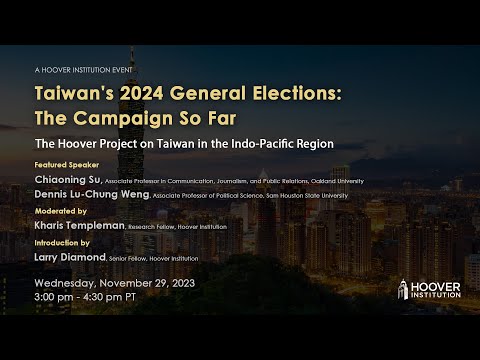
On behalf of Taiwan in the Indo-Pacific Region, the Hoover Institution held Taiwan's 2024 General Elections: The Campaign So Far on Wednesday, November 29, 2023 from 3:00 - 4:30 pm PT.
On January 13, 2024, Taiwan voters will go to the polls to elect a new president and legislature. The results could have major implications for Taiwan’s relationship with the United States and the People’s Republic of China (PRC), as well as the peace and stability of the Indo-Pacific.
In this event, three experts on Taiwan’s domestic politics weigh in on the state of the race, including the leading presidential candidates and parties, the messages of each campaign, and the issues animating the race so far. As the campaign enters the home stretch, they discuss the role of the PRC and the United States in the election, the most likely outcomes, and the consequences for the trilateral U.S.-Taiwan-PRC relationship.
FEATURING
Chiaoning Su is an Associate Professor in the Department of Communication, Journalism, and Public Relations at Oakland University, where she also serves as the Director of the Barry M. Klein Center for Culture and Globalization. Su is a communication scholar (Ph.D., 2015, Temple University) with a dual focus on two interrelated strands: the journalism of crisis and journalism in crisis. Her first line of inquiry delves into the representation and production of crisis news, while her second line of research centers on the role of journalism in the context of diminishing democracy. Her work has been published in Media, Culture, and Society, International Journal of Communication, Asian Journal of Communication, Taiwan Journal of Democracy, and Communication Review. Prior to her academic career, Su gained valuable professional experience as a communication specialist at Ogilvy Public Relations and worked on several political campaigns in Taiwan.
Dennis Lu-Chung Weng is an Associate Professor of Political Science at Sam Houston State University and the founding Director of the Asia Pacific Peace Research Institute (APPRI). He obtained his Ph.D. from the University of Texas at Dallas in 2014. Dr. Weng has formerly taught at institutions including Wesleyan University and SUNY-Cortland. He currently holds research fellowships at Stellenbosch University and National Chengchi University, Taiwan. His research centers on comparative politics, international relations, and the dynamics between domestic political behavior and international politics, particularly in the US and Asia-Pacific regions. A recognized expert in his field, Dr. Weng's insights have been featured in scholarly publications, op-eds, and various media outlets. He is a noted commentator on US China-Taiwan relations and political events in both the US and Asia.
MODERATOR
Kharis Templeman is a research fellow at the Hoover Institution and part of the Project on Taiwan in the Indo-Pacific. Templeman is a political scientist (Ph.D. 2012, Michigan) with research interests in Taiwan politics, democratization, elections and election management, party system development, and politics and security issues in Pacific Asia.
INTRODUCTION BY
Larry Diamond is the William L. Clayton Senior Fellow at the Hoover Institution, the Mosbacher Senior Fellow in Global Democracy at the Freeman Spogli Institute for International Studies (FSI), and a Bass University Fellow in Undergraduate Education at Stanford University. He is also professor, by courtesy, of political science and sociology at Stanford. He co-chairs the Hoover Institution’s programs on China’s Global Sharp Power and on Taiwan in the Indo-Pacific Region.
,1,November 14, 2023
Hoover Institution | Stanford University
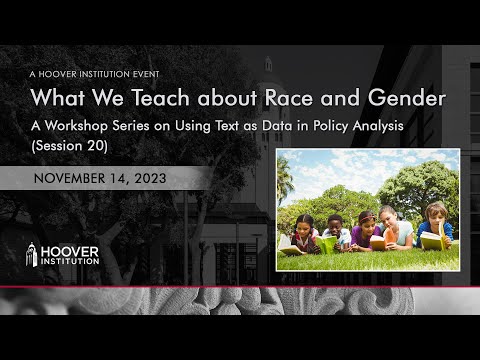
Anjali Adukia, Alex Eble, Emileigh Harrison, Hakizumwami Birali Runesha, and Teodora Szasz speaking on What We Teach about Race and Gender.
The Hoover Institution hosts a seminar series on Using Text as Data in Policy Analysis, co-organized by Steven J. Davis and Justin Grimmer. These seminars will feature applications of natural language processing, structured human readings, and machine learning methods to text as data to examine policy issues in economics, history, national security, political science, and other fields.
Our 20th meeting features a conversation with Anjali Adukia, Alex Eble, Emileigh Harrison, Hakizumwami Birali Runesha, and Teodora Szasz on What We Teach about Race and Gender on Tuesday, November 14, 2023 from 9:00AM – 10:30AM PT.
Anjali Adukia is an assistant professor at the University of Chicago Harris School of Public Policy and the College and the director of the MiiE Lab (Messages, Identity, and Inclusion in Education). In her work, she is interested in understanding how to reduce inequalities such that children from historically disadvantaged backgrounds have equal opportunities to fully develop their potential.
Alex Eble is Associate Professor of Economics and Education at Columbia’s graduate school of education, Teachers College. His research focuses primarily on two key themes: the economics of education in low-income contexts, and the economics of beliefs and information applied to education and inequality.
Emileigh Harrison is a PhD candidate studying Public Policy at the University of Chicago. Her research focuses on understanding barriers to education (such as financial constraints or beliefs about academic abilities shaped by representation) and the role that education policy can play in eliminating them.
Hakizumwami Birali Runesha is the Associate Vice President for Research Computing and founding Director of the Research Computing Center (RCC) at The University of Chicago. He is the former Director of Scientific Computing and Applications at the University of Minnesota Supercomputing Institute, Research Associate at the Hong Kong University of Science and Technology and Assistant Professor in the Civil Engineering Department at the University of Kinshasa. Dr Runesha has more than 28 years of experience in high performance computing, data science and scientific software development.
Teodora Szasz is an Innovation Director at Philips, managing innovation projects (such as AI-based diagnosis of cardiac diseases) between Philips and UChicago Medicine.
Steven Davis is the Thomas W. And Susan B. Ford Senior Fellow at the Hoover Institution and professor of economics at the University of Chicago Booth School of Business. He studies business dynamics, labor markets, and public policy. He advises the U.S. Congressional Budget Office and the Federal Reserve Bank of Atlanta, co-organizes the Asian Monetary Policy Forum and is co-creator of the Economic Policy Uncertainty Indices, the Survey of Business Uncertainty, and the Survey of Working Arrangements and Attitudes.
Justin Grimmer is a senior fellow at the Hoover Institution and a professor in the Department of Political Science at Stanford University. His current research focuses on American political institutions, elections, and developing new machine-learning methods for the study of politics.
,1,Clip from the Joe Rogan Experience #1945 with Eric Weinstein discussing UFO's and whether they are studying or observing us humans.
#joerogan #jre #joeroganexperience #ufo
,1,The Hoover Institution and Stanford University School of Engineering announced an innovative project and publication dedicated to exploring the breakthroughs and policy implications of cutting-edge technologies that are shaping our societies and economies.
https://setr.stanford.edu/
In this video, the Review’s esteemed co-chairs, Condoleezza Rice, director of the Hoover Institution, and Jennifer Widom, dean of the School of Engineering at Stanford University, provide highlights of this unique collaboration. The partnership combines scientific expertise from leading Stanford researchers in ten emerging technology areas with policy insights provided by the Hoover fellowship.
Rice and Widom describe how the Review will conduct a comprehensive examination and analysis of the policy implications surrounding Artificial Intelligence, Biotechnology and Synthetic Biology, Space Technologies, and other critical areas. The video strongly emphasizes the imperative of using these technologies responsibly and sheds light on potential risks if autocracies and other malign actors gain undue advantages.
Further, the video underscores the pivotal role academia plays in nurturing scientific research and understanding. Rice and Widom illustrate how the Stanford Emerging Technology Review aims to initiate a vital conversation about navigating our rapidly evolving future. This dialogue, led by expert voices at the forefront of scientific research and public policy, emphasizes the necessity for responsible innovation and thoughtful consideration of the challenges that lie ahead.
Learn more about the Stanford Emerging Technology Review at https://setr.stanford.edu/.
Featured in the Video
Condoleezza Rice is the Tad and Dianne Taube Director of the Hoover Institution and Thomas and Barbara Stephenson Senior Fellow on Public Policy. She is also the Denning Professor in Global Business and the Economy at the Stanford Graduate School of Business. She is a founding partner of Rice, Hadley, Gates & Manuel LLC, an international strategic consulting firm. From January 2005 to January 2009, Rice served as the 66th Secretary of State of the United States, the second woman and first black woman to hold the post. Rice also served as assistant to the president for national security affairs (National Security Advisor) from January 2001 to January 2005, the first woman to hold the position.
Jennifer Widom is the Frederick Emmons Terman Dean of the School of Engineering and the Fletcher Jones Professor in Computer Science and Electrical Engineering at Stanford University. She served as Computer Science Department chair from 2009-2014 and School of Engineering senior associate dean from 2014-2016. Widom received her Bachelor's degree from the Indiana University Jacobs School of Music in 1982 and her Computer Science Ph.D. from Cornell University in 1987. She was a research staff member at the IBM Almaden Research Center before joining the Stanford faculty in 1993. Her research interests span many aspects of nontraditional data management. She is an ACM Fellow and a member of the National Academy of Engineering and the American Academy of Arts & Sciences; she received a Guggenheim Fellowship in 2000, the ACM SIGMOD Edgar F. Codd Innovations Award in 2007, the ACM-W Athena Lecturer Award in 2015, and the EPFL-WISH Foundation Erna Hamburger Prize in 2018.
,1,Biblical Hebrew partial scholarship: https://goo.gl/AK3MUw
For centuries, the Holy Bible has been a source of inspiration for people all over the world. It is the most widely distributed book today. The Bible is a part of our modern world and has influenced the foundations of Western culture. The Israel Institute of Biblical Studies aims to make the Bible accessible, live from Israel, to people around the world. Through Biblical study and language courses students connect with teachers in the Holy Land to learn the original languages of the Old and New Testaments. This allows them to interpret the holy texts themselves, while discovering the ancient land of the Bible where the stories took place. Find out more about the Old and New Testaments through the Jewish studies, and the connection between Judaism and Christianity.
Students benefit from a full educational experience with an entirely new dimension that immerses them in the Bible's texts, land, people, language, and culture. Our supportive and social learning environment ensures that students are academically challenged through the in-depth study of the Bible. Professional and passionate teachers from the Holy Land of Israel lead each online course, including: Exploring the Biblical Land of Israel, Discovering the Hebrew Bible, Modern Hebrew, Biblical Hebrew and Biblical Greek. Learn the ancient languages of the original Bible, the Torah, and dive into the scriptures to learn the original meaning of the holy texts! The Israel Institute of Biblical Studies has been recognized by the Hebrew University of Jerusalem and the world as a prestigious academy for the study of Biblical languages, culture, and history.
Did you know that the Biblical Hebrew alphabet is different than the Modern Hebrew alphabet? Even Biblical Hebrew verbs, phrases, punctuation, syntax, and more are all different, and important to understanding ancient Holy Scriptures. The Israel Institute of Biblical Studies offers students the best teachers and a strong and supportive community combined with advanced technology that makes our live courses available to anyone anywhere in the world. Students can learn in their own time and even in their own language.
Uncover hidden meanings and deepen your understanding of the Holy Scriptures - Biblical Hebrew partial scholarship: https://goo.gl/AK3MUw
,1,January 30, 2024
Hoover Institution | Stanford University
Our 22nd meeting features a conversation with Elina Ribakova, Piroska Nagy Mohácsi, Tatiana Evdokimova, and Olga Ponomarenko on Central Banks and Policy Communication: How Emerging Markets Have Outperformed the Fed and ECB on Tuesday, January 30, 2024 from 9:00AM – 10:30AM PT.
Elina Ribakova, Piroska Nagy Mohácsi, Tatiana Evdokimova, and Olga Ponomarenko speaking on Central Banks and Policy Communication: How Emerging Markets Have Outperformed the Fed and ECB.
The Hoover Institution hosts a seminar series on Using Text as Data in Policy Analysis, co-organized by Steven J. Davis and Justin Grimmer. These seminars will feature applications of natural language processing, structured human readings, and machine learning methods to text as data to examine policy issues in economics, history, national security, political science, and other fields.
Elina Ribakova is a nonresident senior fellow at the Peterson Institute for International Economics. She is also a nonresident fellow at the Brussels-based economic policy think tank Bruegel and a director of the International Affairs Program and vice president for foreign policy at the Kyiv School of Economics. Her research focuses on global markets, economic statecraft, and economic sovereignty. She has been a senior adjunct fellow at the Center for a New American Security (2020–23) and a research fellow at the London School of Economics (2015–17).
Piroska Nagy Mohácsi is a visiting professor at the Firoz Lalji Global Hub & Institute for Africa at the London School of Economics and Political Science. Her key research areas include financial resilience and stability, central bank reform, digital currencies, fiscal and monetary policy mix and related governance issues, and emerging-market policies. She previously held senior positions at the EBRD (2008-15), the IMF (1986-2008), and Fitch Ratings (2003-4).
Tatiana Evdokimova is the senior economist at the Joint Vienna Institute. She previously worked in the emerging markets research team of Nordea Bank, where she was responsible for macroeconomic analysis and forecasting with a focus on financial market trends. Prior to that, she was an economist at the economic service of the French embassy in Moscow conducting analytical research on economic developments in countries of Eastern Europe, the Caucasus, and Central Asia. Evdokimova holds a PhD in international economics. Her research interests lie in the areas of monetary policy, international capital flows, and climate change.
Olga Ponomarenko has been the head of quantitative analytics at Caplight since 2021. She previously worked as a quantitative analyst at Barclays and economist at the European Bank for Reconstruction and Development.
Steven J. Davis is the Thomas W. and Susan B. Ford Senior Fellow at the Hoover Institution and Senior Fellow at the Stanford Institute for Economic Policy Research. He studies business dynamics, labor markets, and public policy. He advises the U.S. Congressional Budget Office and the Federal Reserve Bank of Atlanta, co-organizes the Asian Monetary Policy Forum and is co-creator of the Economic Policy Uncertainty Indices, the Survey of Business Uncertainty, and the Survey of Working Arrangements and Attitudes. Davis hosts “Economics, Applied,” a podcast series sponsored by the Hoover Institution.
Justin Grimmer is a senior fellow at the Hoover Institution and a professor in the Department of Political Science at Stanford University. His current research focuses on American political institutions, elections, and developing new machine-learning methods for the study of politics.