,Ri,Royal Institution,royal institute,WfCItXZ7dFo,UCYeF244yNGuFefuFKqxIAXw, Knowledge, channel_UCYeF244yNGuFefuFKqxIAXw, video_WfCItXZ7dFo,2025 is the International Year of Quantum Science and Technology, as marked by the UN, to celebrate 100 years since the birth of quantum mechanics. But quantum science is one of the least diverse areas of science in terms of gender and other protected characteristics.
Jess Wade, a physicist and lecturer in functional materials at Imperial College London, has been fighting the inequality in quantum physics and beyond by creating thousands of Wikipedia pages for women scientists. Jess joins us this month to discuss the past, present, and future of quantum science along with what can be done to increase diversity within the field.
Ri Science Podcast episodes are released on the last Wednesday of every month. Subscribe wherever you get your podcasts to be notified as soon as episodes are released!
---
Jess Wade is a British physicist in the Blackett Laboratory at Imperial College London, specialising in Raman spectroscopy. Her research investigates polymer-based organic light emitting diodes (OLEDs). Her public engagement work in science, technology, engineering, and mathematics (STEM) advocates for women in physics as well as tackling systemic biases such as gender and racial bias on Wikipedia. Read more about here here: https://en.wikipedia.org/wiki/Jess_Wade
---
Producer: Lia Hale
Assistant producers: Katie Mortimer, Isla Nakano
Interviewer: Lia Hale
Music: Joseph Sandy
--
Join this channel to get access to perks:
https://www.youtube.com/channel/UCYeF244yNGuFefuFKqxIAXw/join
Subscribe for regular science videos: http://bit.ly/RiSubscRibe
The Ri is on Twitter: http://twitter.com/ri_science
and Facebook: http://www.facebook.com/royalinstitution
and TikTok: https://www.tiktok.com/@ri_science
Listen to the Ri podcast: https://podcasters.spotify.com/pod/show/ri-science-podcast
Donate to the RI and help us bring you more lectures: https://www.rigb.org/support-us/donate-ri
Our editorial policy: https://www.rigb.org/editing-ri-talks-and-moderating-comments
Subscribe for the latest science videos: http://bit.ly/RiNewsletter
Product links on this page may be affiliate links which means it won't cost you any extra but we may earn a small commission if you decide to purchase through the link.
,Ri,Royal Institution,royal institute,MdOCu2Gr-0g,UCYeF244yNGuFefuFKqxIAXw, Knowledge, channel_UCYeF244yNGuFefuFKqxIAXw, video_MdOCu2Gr-0g,Join this channel to get access to perks:
https://www.youtube.com/channel/UCYeF244yNGuFefuFKqxIAXw/join
Subscribe for regular science videos: http://bit.ly/RiSubscRibe
The Ri is on Twitter: http://twitter.com/ri_science
and Facebook: http://www.facebook.com/royalinstitution
and TikTok: https://www.tiktok.com/@ri_science
Listen to the Ri podcast: https://podcasters.spotify.com/pod/show/ri-science-podcast
Donate to the RI and help us bring you more lectures: https://www.rigb.org/support-us/donate-ri
Our editorial policy: https://www.rigb.org/editing-ri-talks-and-moderating-comments
Subscribe for the latest science videos: http://bit.ly/RiNewsletter
Product links on this page may be affiliate links which means it won't cost you any extra but we may earn a small commission if you decide to purchase through the link.
,Ri,Royal Institution,royal institute,PLc0BCjbFcg,UCYeF244yNGuFefuFKqxIAXw, Knowledge,Religion, channel_UCYeF244yNGuFefuFKqxIAXw, video_PLc0BCjbFcg,In the first of his CHRISTMAS LECTURES, Richard Dawkins explores the origins of life. Beginning with a look at our ancestry, he shows how the probability of our existence is very small.
Watch all the lectures in this series here: https://www.youtube.com/playlist?list=PLbnrZHfNEDZwJw3_jDeusmHuVYDdKRpo9
Watch our newest Christmas lectures here: https://www.youtube.com/playlist?list=PLbnrZHfNEDZyQJZLPMjwEoOLdkFBLU2m1
This lecture was filmed at the Ri on 1 December 1991.
These lectures were originally a YouTube member exclusive for our Science Supporters, and now we’re putting them out for everyone to watch. If you can’t wait for them all to be published, get access now by signing up as a YouTube channel member, and help us bring science to more people: https://www.youtube.com/channel/UCYeF244yNGuFefuFKqxIAXw/join
---
Life grows up in the universe by gradual degrees of evolution. Billions of years ago, there existed a vast population of bacteria. But it was only an elite group of these bacteria that evolved to become humans. In truth, we are lucky to be alive.
In the first of his CHRISTMAS LECTURES, Richard Dawkins explores the origins of life. Beginning with a look at our ancestry, he shows how the probability of our existence is very small. Becoming an ancestor is much more difficult than simple reproduction, and Richard reveals how our ancestors did what it took to survive and pass on their genes.
But although some of our life must be devoted to perpetuating it, surely there must be more to it? Richard explores the role of art and culture in society, and examines how the capabilities of the human body have enabled us to accomplish complex tasks.
When it comes to our understanding of the meaning of life, science is important. As Richard explains, science can help us uncover both when we arrived on this planet, and why we are here. Some people turn to the supernatural for the answer to such questions. Richard looks at the limitations of beliefs in the supernatural and uses a cannonball to prove why instead we should have faith in science and its predictions.
--
About the 1991 CHRISTMAS LECTURES
The world-famous evolutionary biologist Richard Dawkins presents the CHRISTMAS LECTURES on "our own growing knowledge of how life grows up in the universe."
Just as children grow up to be adults, so too does life gradually evolve on a planet over thousands of generations, to move from “nonliving simplicity” to become “living complexity”.
Combining beautiful writing with a range of illuminating demonstrations, the series featured a variety of wildlife, a virtual reality Lecture Theatre, and special guests – including the late Douglas Adams reading an excerpt from The Hitchhiker's Guide to the Galaxy.
Find out more about the Ri CHRISTMAS LECTURES here: https://www.rigb.org/christmas-lectures
---
Join this channel to get access to perks:
https://www.youtube.com/channel/UCYeF244yNGuFefuFKqxIAXw/join
Subscribe for regular science videos: http://bit.ly/RiSubscRibe
The Ri is on Twitter: http://twitter.com/ri_science
and Facebook: http://www.facebook.com/royalinstitution
and TikTok: https://www.tiktok.com/@ri_science
Listen to the Ri podcast: https://podcasters.spotify.com/pod/show/ri-science-podcast
Donate to the RI and help us bring you more lectures: https://www.rigb.org/support-us/donate-ri
Our editorial policy: https://www.rigb.org/editing-ri-talks-and-moderating-comments
Subscribe for the latest science videos: http://bit.ly/RiNewsletter
Product links on this page may be affiliate links which means it won't cost you any extra but we may earn a small commission if you decide to purchase through the link.
,Ri,Royal Institution,royal institute,sO5adbV_mu8,UCYeF244yNGuFefuFKqxIAXw, Knowledge, channel_UCYeF244yNGuFefuFKqxIAXw, video_sO5adbV_mu8,Watch the Q&A for Sean Carroll's lecture on Einstein's equation explaining spacetime. You can watch the original lecture here: https://youtu.be/BRudidBcfXk
The original lecture and this Q&A were recorded at the Ri on Monday 14 August 2023.
Our lecture Q&As are usually a perk for our YouTube Science Supporters, as a thank you for helping us bring science to more people, but we're publishing this one for everyone as Sean's talk has been so popular.
A huge thank you to our YouTube members for helping us to bring you more science. You can join them here: https://www.youtube.com/channel/UCYeF244yNGuFefuFKqxIAXw/join
Subscribe for regular science videos: http://bit.ly/RiSubscRibe
The Ri is on Twitter: http://twitter.com/ri_science
and Facebook: http://www.facebook.com/royalinstitution
and TikTok: https://www.tiktok.com/@ri_science
Listen to the Ri podcast: https://podcasters.spotify.com/pod/show/ri-science-podcast
Our editorial policy: https://www.rigb.org/editing-ri-talks-and-moderating-comments
Subscribe for the latest science videos: http://bit.ly/RiNewsletter
Product links on this page may be affiliate links which means it won't cost you any extra but we may earn a small commission if you decide to purchase through the link.
,1,Join this channel to get access to perks:
https://www.youtube.com/channel/UCYeF244yNGuFefuFKqxIAXw/join
Subscribe for regular science videos: http://bit.ly/RiSubscRibe
The Ri is on Twitter: http://twitter.com/ri_science
and Facebook: http://www.facebook.com/royalinstitution
and TikTok: https://www.tiktok.com/@ri_science
Listen to the Ri podcast: https://podcasters.spotify.com/pod/show/ri-science-podcast
Donate to the RI and help us bring you more lectures: https://www.rigb.org/support-us/donate-ri
Our editorial policy: https://www.rigb.org/editing-ri-talks-and-moderating-comments
Subscribe for the latest science videos: http://bit.ly/RiNewsletter
Product links on this page may be affiliate links which means it won't cost you any extra but we may earn a small commission if you decide to purchase through the link.
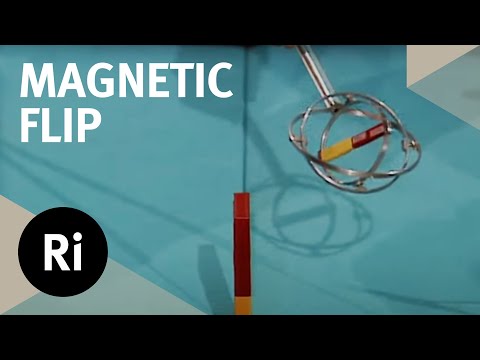
,1,Volcanic rocks contain small bits of iron oxide that get magnetised in the direction of the Earth's magnetic field as they cool. Comparing rocks of different ages reveals the magnetic history of our planet.
Watch the full second lecture of the series: https://www.rigb.org/christmas-lectures/watch/1995/planet-earth-an-explorers-guide/secrets-of-the-deep?utm_source=youtube&utm_medium=social&utm_term=description
James Jackson gave the 1995 Christmas Lectures "Planet Earth: An Explorer's Guide" about the inner workings of planet Earth.
The second lecture "Secrets of the Deep", where this clip is from, is about the crucial role plate tectonics play in the structure of our oceans and continents.
Watch the full series:
https://www.rigb.org/christmas-lectures/watch/1995/planet-earth-an-explorers-guide?utm_source=youtube&utm_medium=social&utm_term=description
Christmas Lectures are a popular children's science show broadcast every year on the BBC. As such they fall under YouTube's 'Made for Kids' category, which means that some common features are disabled on this video, such as comments, cards and end screens.
The Ri is on Twitter: http://twitter.com/ri_science
and Facebook: http://www.facebook.com/royalinstitution
and Tumblr: http://ri-science.tumblr.com/
Our editorial policy: http://www.rigb.org/home/editorial-policy
Subscribe for the latest science videos: http://bit.ly/RiNewsletter
,1,On Thursday, November 30, 2023 the Hoover Institution hosted Governors Wes Moore (D-Maryland) and Christopher Sununu (R-New Hampshire) in conversation with Hoover Institution Director Condoleezza Rice to offer perspectives on the state of American institutions. In a bipartisanship spirit, the governors and Director Rice shared insights on how trust in and the efficacy of governmental institutions can be improved as well as the challenges of doing so in a polarized environment. Panelists shared their perspectives as chief executives and weighed in on reforms to improve democracy at all levels of government.
For more information visit, https://www.hoover.org/events/executive-leadership-polarized-era-rebuilding-trust-american-institutions.
ABOUT THE SPEAKERS
Governor Wes Moore is the 63rd Governor of the state of Maryland and is the state’s first Black Governor. Moore earned an Associate’s degree from Valley Forge Military Academy and College and was commissioned as a second lieutenant in the U.S. Army. He earned his Bachelor’s in international relations and economics at Johns Hopkins University in Baltimore, where he graduated Phi Beta Kappa and was the university’s first Black Rhodes Scholar. Moore served as a captain in the 82nd Airborne Division in Afghanistan and was the CEO of the Robin Hood Foundation. He also worked in finance with Deutsche Bank in London and with Citigroup in New York. He and his wife Dawn Flythe Moore have two children.
Governor Christopher Sununu
Governor Christopher Sununu is the 82nd Governor of the State of New Hampshire and is currently serving his fourth term, receiving in 2020 more votes ever than any candidate in state history. With Governor Sununu's leadership, New Hampshire is ranked the #1 state in the country for personal freedoms by Cato Institute. Chris grew up in Salem, NH. He graduated from Massachusetts Institute of Technology (M.I.T.) with a BS in Civil/Environmental Engineering. As an environmental engineer, Chris worked for ten years cleaning up hazardous waste sites across the country. Governor Sununu lives in Newfields with his wife, Valerie, and their three children.
condoleezza rice image
Condoleezza Rice is the Tad and Dianne Taube Director of the Hoover Institution and a Senior Fellow on Public Policy. She is the Denning Professor in Global Business and the Economy at the Stanford Graduate School of Business. In addition, she is a founding partner of Rice, Hadley, Gates & Manuel LLC, an international strategic consulting firm.
ABOUT RAI
The Center for Revitalizing American Institutions in multiple ways affirms the purpose for which Herbert Hoover created the Hoover Institution. Through scholarship, policy analysis, and dissemination of findings, RAI will help the nation meet the current existential challenges to our institutions. By giving definition to the problem and approaching it holistically, RAI is a resource for improving the current situation and encouraging an informed and active citizenry.
For more information on the Center for Revitalizing Institutions, visit https://www.hoover.org/research-teams/center-revitalizing-american-institutions.
,1,The United States Supreme Court ruled that classroom diversity is no longer a compelling interest to justify using race in college admissions, overturning past precedents that had upheld affirmative action for decades. Race alone can no longer act as an adequate substitute for the diversity of perspectives and ideas that students bring. Race-based affirmative action now faces new legal vulnerabilities, including potential lawsuits against other private and public institutions.
,1,Clip from the Joe Rogan Experience #1945 with Eric Weinstein discussing the war between Russia and Ukraine, and the possibility of World War 3.
#joerogan #jre #joeroganexperience #russiaukraine
,1,January 31, 2024
Hoover Institution | Stanford University
Jesús Fernández-Villaverde, the Howard Marks Presidential Professor of Economics at the University of Pennsylvania, discussed “The Wealth of Working Nations,” a paper with Gustavo Ventura (Arizona State University) and Wen Yao (Tsinghua University).
PARTICIPANTS
Jesús Fernández-Villaverde, John Taylor, Annelise Anderson, Michael Boskin, Doug Branch, Pedro Carvalho, John Cochrane, Chris Dauer, Steve Davis, Sebastian Di Tella, David Fedor, Jared Franz, Bob Hall, Adele Hayutin, Gregory Hess, Laurie Hodrick, Robert Hodrick, Chad Jones, Ken Judd, Matthew Kahn, Pete Klenow, Evan Koenig, David Laidler, Oliver Landmann, John Lipsky, Lee Ohanian, Robert Oster, Radek Paluszynski, Elena Pastorino, Paul Peterson, Alvin Rabushka, Valerie Ramey, Richard Sousa, Tom Stephenson, Jack Tatom, George Tavlas, Yevgeniy Teryoshin, Chris Tonetti, Victor Valcarcel, Gustavo Ventura
ISSUES DISCUSSED
Jesús Fernández-Villaverde, the Howard Marks Presidential Professor of Economics at the University of Pennsylvania, discussed “The Wealth of Working Nations,” a paper with Gustavo Ventura (Arizona State University) and Wen Yao (Tsinghua University).
John Taylor, the Mary and Robert Raymond Professor of Economics at Stanford University and the George P. Shultz Senior Fellow in Economics at the Hoover Institution, was the moderator.
PAPER SUMMARY
Due to population aging, GDP growth per capita and GDP growth per working-age adult have become quite different among many advanced economies over the last several decades. Countries whose GDP growth per capita performance has been lackluster, like Japan, have done surprisingly well in terms of GDP growth per working-age adult. Indeed, from 1998 to 2019, Japan has grown slightly faster than the U.S. in terms of per working-age adult: an accumulated 31.9% vs. 29.5%. Furthermore, many advanced economies appear to be on parallel balanced growth trajectories in terms of working-age adults despite important differences in levels. Motivated by this observation, we calibrate a standard neoclassical growth model in which the growth of the working-age adult population varies in line with the data for each economy. Despite the underlying demographic differences, the calibrated model tracks output per workingage adult in most economies of our sample. Our results imply that the growth behavior of mature, aging economies is not puzzling from a theoretical perspective.
To read the paper, click the following link
https://www.sas.upenn.edu/%7Ejesusfv/Wealth_Working_Nations.pdf
To read the slides, click the following link
https://www.hoover.org/sites/default/files/2024-02/Slides_Hoover.pdf